
HENLEY ROYAL REGATTA
Late June into July · The Henley Reach, Henley-on-Thames · Six Days · Since 1839
2027: 29 June to 4 July
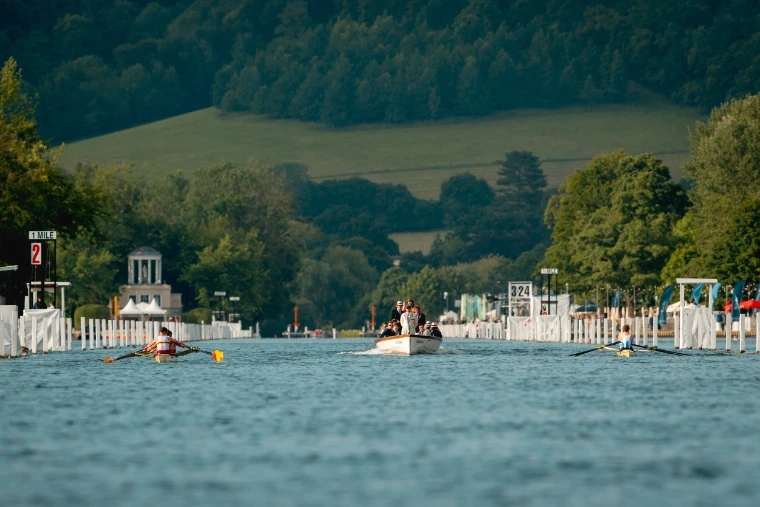
Henley Royal Regatta is six days of rowing at the start of July on the Henley Reach of the Thames: more than four hundred races, every one of them two crews side by side over a mile and 550 yards, upstream from Temple Island to the finish below the town. Every event is a knockout, from schoolboys’ eights to Olympic champions in single sculls, and the finals are rowed on the Sunday. It is run by the Stewards, who have elected one another since 1885.
The cup the winning eight lifts on the Sunday was given in 1964 by the Harvard crew that had won it fifty years before. The one bought in 1839 is too fragile to use.
The Reach
On 26 March 1839 Captain Edmund Gardiner rose at a public meeting in Henley Town Hall and proposed an annual regatta, “under judicious and respectable management”, for the crowds the boat races on the reach had lately been drawing. The first was rowed that summer on a single afternoon, with a fair beside it, and First Trinity, Cambridge, won the Grand Challenge Cup for eights, a silver cup bought for a hundred guineas, by half a length. From 1840 the racing took two days.
In 1851 the Stewards asked Prince Albert to be the regatta’s patron, and he agreed. It has been Royal ever since, and each sovereign has renewed the patronage; the King accepted it in May 2024.
The course is a mile and 550 yards because that was the longest stretch of open water the reach would give in 1839. It was bent at first, and for twenty years the crew on the Berkshire side won more than half the races. Since 1924 it has run straight and eighty feet wide, cut through part of Temple Island and the Berkshire bank. The temple on the island, built by James Wyatt in 1771 as a fishing lodge, has belonged to the Stewards since 1987, on a lease of 999 years.
Henley was long kept for gentlemen. In 1920 John B. Kelly of Philadelphia, who had been a bricklayer’s apprentice, was refused an entry, as a man who had worked with his hands and a member of a club barred since 1906. The rule against manual workers went in 1937. His son won the Diamond Sculls in 1947, and his daughter, Princess Grace of Monaco, gave away the prizes in 1981.
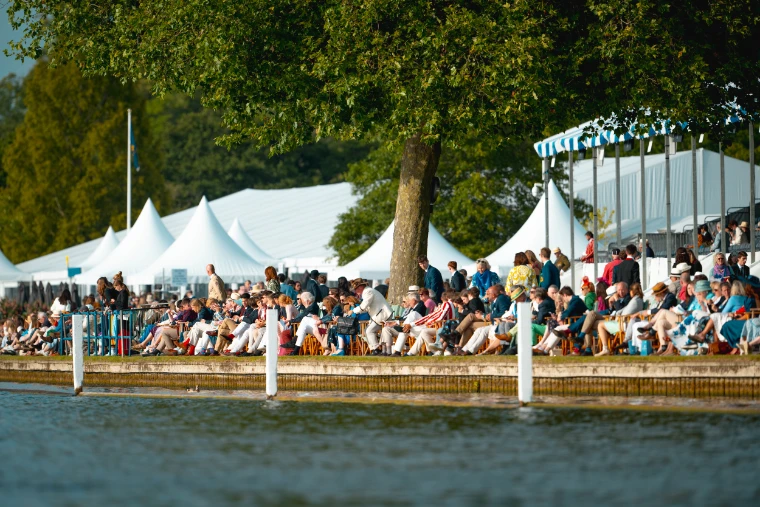
The Stewards’ Enclosure, opposite the finish, opened in 1919 as a members’ club. Its waiting list runs from four to ten years.
The Six Days
Racing goes from Tuesday to the first Sunday of July. The regatta grew a day at a time: two in 1840, three in 1886, four in 1906, five in the 1980s, and six from 2022, to make room for new events for women.
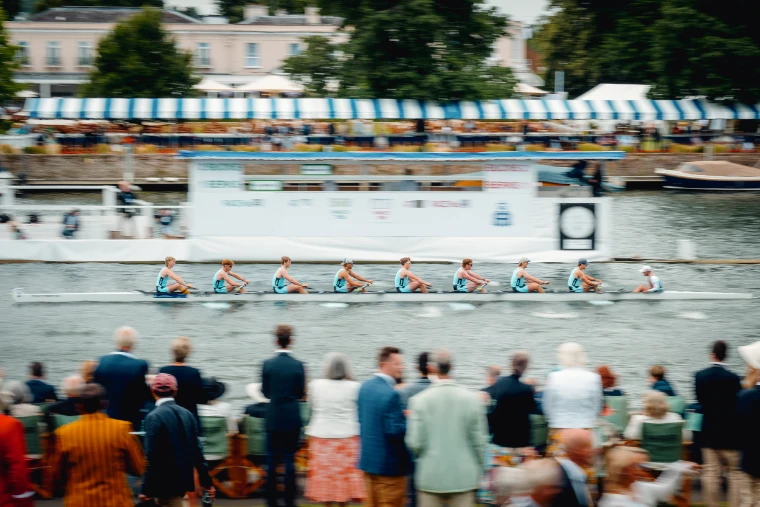
There are thirty events, each a knockout, and each race is two crews, one on the Berkshire station and one on the Buckinghamshire, between two lines of booms. A crew that leaves its station can be disqualified, and a cox who hits the booms can lose the race, as the University of Washington did in the final of the Grand in 2024.
The draw is made in public in the Town Hall on the Saturday before, the names drawn from the Grand Challenge Cup itself. The early days are full of heats from the morning on. The finals are rowed on the Sunday, and the prizes given at five o’clock in the Stewards’ Enclosure.
The Grand, for eights, is the oldest event and the best known. Leander, whose clubhouse stands by the bridge, has won it thirty-six times.
In 2026, from 30 June to 5 July, the Grand went to the British eight, rowing as Oxford Brookes and Leander, by three lengths from Italy, and Oliver Zeidler of Germany won the Diamond Sculls for the fifth time.
What to Know
It runs from a Tuesday to the first Sunday in July: in 2027, from 29 June to 4 July. Racing begins in the morning, later at the weekend.
The Regatta Enclosure, beside the course, is open to anyone with a ticket, at £38 to £64 a day, and sells out early. The Stewards’ Enclosure, opposite the finish, admits its members and the guests they nominate.
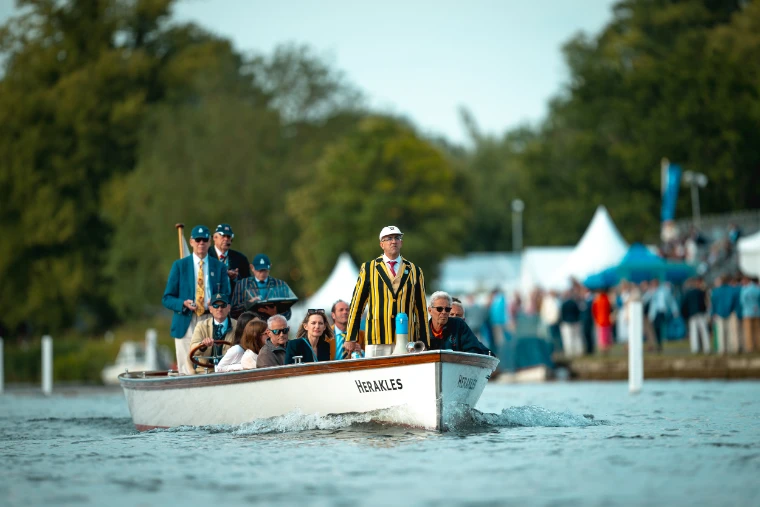
In the Stewards’ Enclosure: a lounge suit, or a jacket or blazer, with a tie or a cravat, and for ladies a dress or skirt below the knee, or trousers with a jacket. Jackets come off only when the Stewards announce it for the day, and the tie stays on. A rowing club’s blazer, however worn, is welcome. The Regatta Enclosure has no rule, and the blazers come out anyway.
The trains go from Paddington, changing at Twyford, in under an hour at best, and the course is a ten-minute walk from Henley station. Leander, by the bridge, and Phyllis Court, opposite the finish, keep rooms; otherwise stay in London.
The mistake is to answer the telephone. Calls are not allowed in the Stewards’ Enclosure, and to talk one leaves it. Texts and photographs are allowed.
The Court
Henley Royal Regatta is not the Court’s own. Badges for the Stewards’ Enclosure, for which only its members can nominate a guest, are sought on a member’s behalf, and the Court arranges the whole of it: getting there, where to stay in Henley or London, and the table afterward. The Court’s own crewing, out of Oyster Bay, begins the same week.
How one becomes a member is set out under Admission.
Set down October MMXXVI