MILLE MIGLIA
Late May · Brescia to Rome · A Week · Since 1927
2027: 24 to 29 May
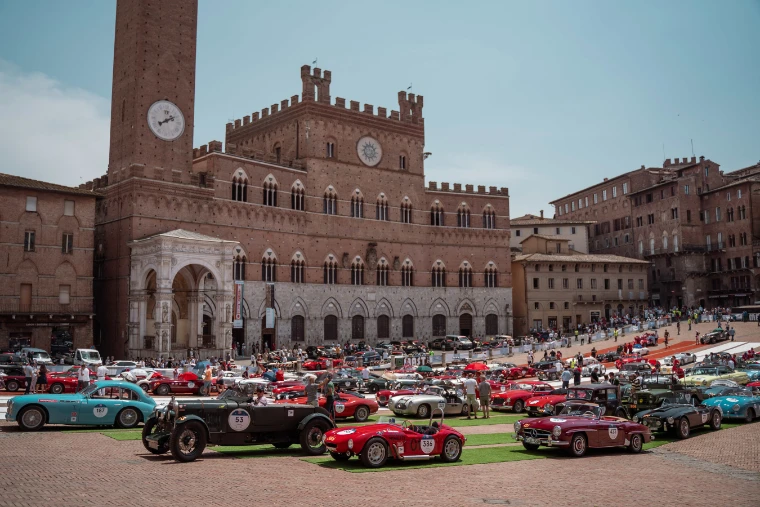
The Mille Miglia is a week of classic cars on the public roads of Italy, in late May, from Brescia to Rome and back: some four hundred of them, each of a model that ran in the race, or was entered for it, between 1927 and 1957.
Enzo Ferrari is credited with calling it the most beautiful race in the world. It is now won not by the fastest crew, but by the most exact.
The Red Arrow
On 2 December 1926 three men from Brescia called on Giovanni Canestrini, a motoring journalist, at his house in Milan: Aymo Maggi and Franco Mazzotti, both counts, and Renzo Castagneto. Brescia had lost the Italian Grand Prix to Monza, and it is said they wanted a race of their own.
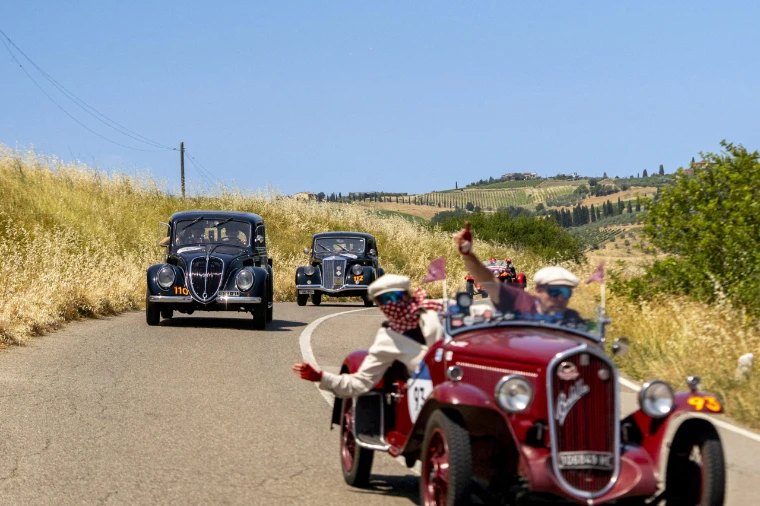
It was to run from Brescia to Rome and back on the open road. Mazzotti thought to measure it in miles rather than kilometres, and to call it the Mille Miglia, the thousand miles. Castagneto marked the way with red arrows lettered in white, and the race is still called the Red Arrow.
The first Mille Miglia set off at eight in the morning on 26 March 1927, in the rain: seventy-seven cars, all Italian and all as sold, at an entry fee of one lira. They drove some sixteen hundred kilometres through fog and dust on unpaved roads, and an OM, built in Brescia, won in a little over twenty-one hours. OMs took the first three places.
In 1930, the story goes, Tazio Nuvolari followed his teammate Achille Varzi through the half-light of dawn with his headlights off, so as not to be seen in his mirrors, and switched them on only as he drew alongside, on the straight roads into Brescia. He won.
Seven Twenty-Two
The smallest, slowest cars were sent off first and the fastest last, so that the roads were closed for as short a time as possible. From 1949 each car carried its starting time as its number.
In 1955 car 722, a Mercedes-Benz, left Brescia at 7.22 in the morning, more than ten hours after the first. Stirling Moss drove it, with Denis Jenkinson, a journalist, beside him. They had driven the route six times beforehand, and Jenkinson had written it out on a roll of paper eighteen feet long, which he read to Moss in fifteen hand signals.
They were back in Brescia ten hours, seven minutes and forty-eight seconds later, at an average of nearly a hundred miles an hour. No one went faster in the two years the race had left.
In 1957 the Ferrari of Alfonso de Portago burst a tyre at Guidizzolo, less than forty miles from the finish, and killed him, his co-driver, Edmund Nelson, and nine spectators, five of them children. The Italian government ended the race, and all racing on its public roads with it.
Twenty years later it was revived for cars of the same kinds, as a trial of regularity, and it has been run every year since 1987. The cars are timed over short stretches, well over a hundred of them, and the crew that keeps most exactly to the times set wins.
In 2026 it was won by Juan Tonconogy, of Argentina, and his sister Margarita, in an Alfa Romeo of 1931, ending Andrea Vesco’s run of six wins in a row.
What to Know
The start and the finish are on Viale Venezia, in Brescia, as they have traditionally been. In between, it stops each night in a different town, with Rome, the turning point, at the end of the third day.
In 2027, a hundred years after the first, it runs from 24 to 29 May, anti-clockwise as the first did, and entries open on 6 October 2026.
Smart casual: the days on the road are long, and the cars come in after dark.
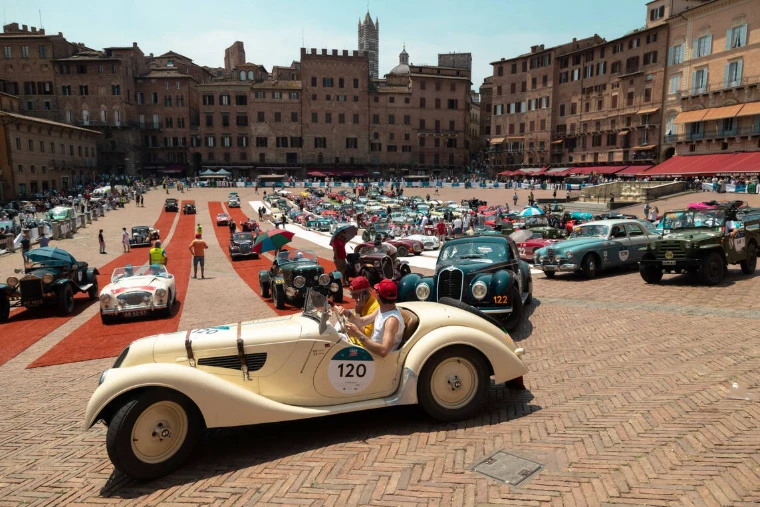
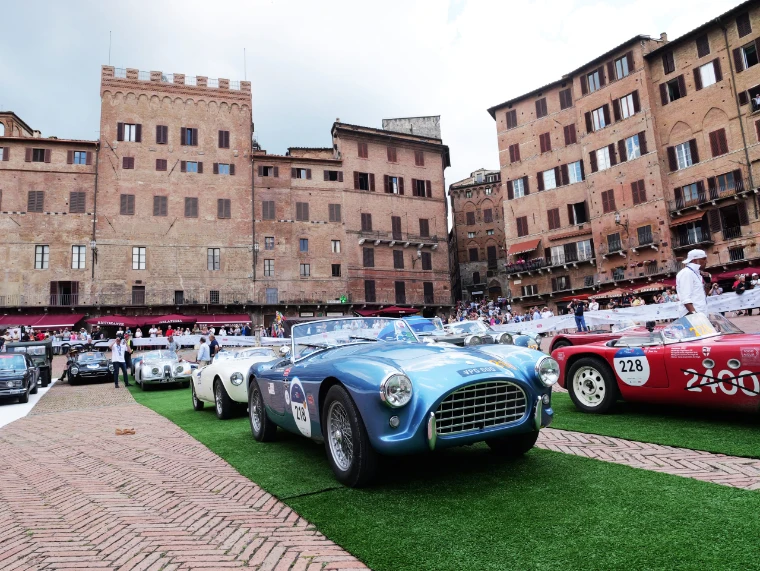
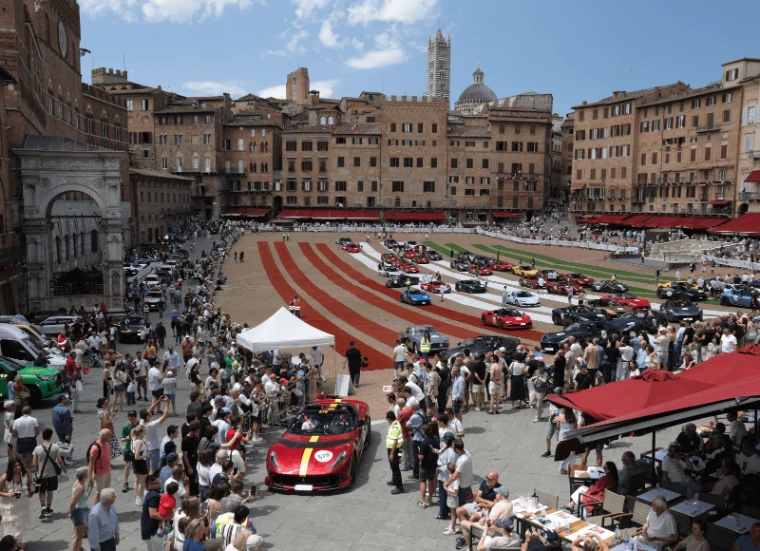
On the road, the place to see them is the lunch halt in the Piazza del Campo, in Siena, on the way south.
Brescia is on the railway between Milan and Verona. Stay in the old town, or on Lake Garda, a short drive east.
The mistake is to come only for the start. The day before, the cars are sealed in Piazza della Vittoria and left on show in the squares of the old town, where they can be looked at standing still.
The Court
The Mille Miglia is not the Court’s own. An entry, for a member with a car that qualifies, or a place in the Ferrari Tribute that runs the same roads, is sought on a member’s behalf, and the Court arranges the whole of it: getting there, where to stay in Brescia and along the way, and the table afterward.
How one becomes a member is set out under Admission.
Set down September MMXXVI · Revised October MMXXVI