
PRIVATE GALLERY AND MUSEUM TOURS
Early April · New York · A Morning · Hosted by the Court
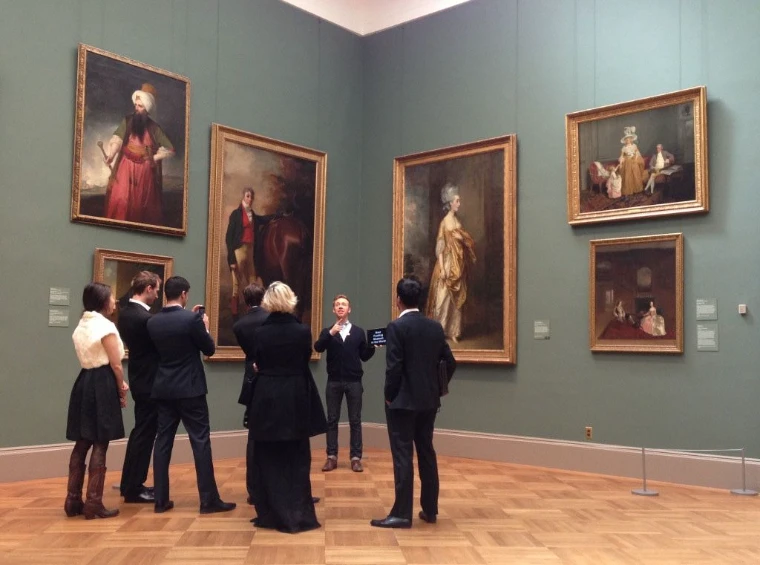
In early April the Court takes ten members into a museum or gallery an hour before the public is let in, in the company of whoever hung the room.
The questions are asked while the galleries are still empty. The Court leaves as the doors open.
The Private View
The private view began as a working day.
Before its annual exhibition opened, the Royal Academy in London gave its members a few days to finish their pictures where they hung: to varnish them, and to adjust them against whatever the hangers had put beside them. They were called varnishing days. The French word, vernissage, is still used for the first sight of an exhibition before the public comes in.
In 1832 Constable’s painting of the opening of Waterloo Bridge, more than a decade in the making and bright with scarlet and gold, was hung beside a grey seascape by Turner. Turner looked at the pair, fetched his palette, and put a single daub of red in the middle of his own sea. “He has been here,” Constable said, “and fired a gun.” Turner stayed away for a day and a half, and then, in the last minutes allowed, shaped the daub into a buoy.
What the varnishing days offered, and a private view still does, is the room before it belongs to anyone: the pictures where the people who chose them put them, and those people still in the building to say why.
The Morning
Ten places, and one room or one exhibition, chosen each spring for what is hanging.
It may be a museum on the eve of an opening, a private collection seen by arrangement, or a gallery before its doors unlock. What matters is who comes with it: the curator who hung it, or the collector who assembled it. Someone who knows why the fourth picture hangs to the left of the third.
An hour, and it ends on time, because the doors open whether or not the Court has finished.
Coffee follows nearby, while the argument about what was seen is still going.
What Is Asked
A lounge suit. The morning ends on the street at an hour when the city is at work.
Arrive on time. A building opened before hours is opened once, and a member who comes after the party has gone in has missed the morning.
Ask. The host has come to be asked, and a room that only nods has wasted them.
Photographs only where the host allows them.
Where a work in the room is for sale, the conversation about it happens afterward, and elsewhere.
The Places
Ten. It is the number a curator can talk to without raising their voice.
Members are written to in February.
The sum is stated in the invitation and covers the whole of the morning.
How one becomes a member is set out under Admission.
Set down September MMXXVI