
THE CLAY SHOOT
Late September · Long Island · An Afternoon · Hosted by the Court
2027: dates to follow
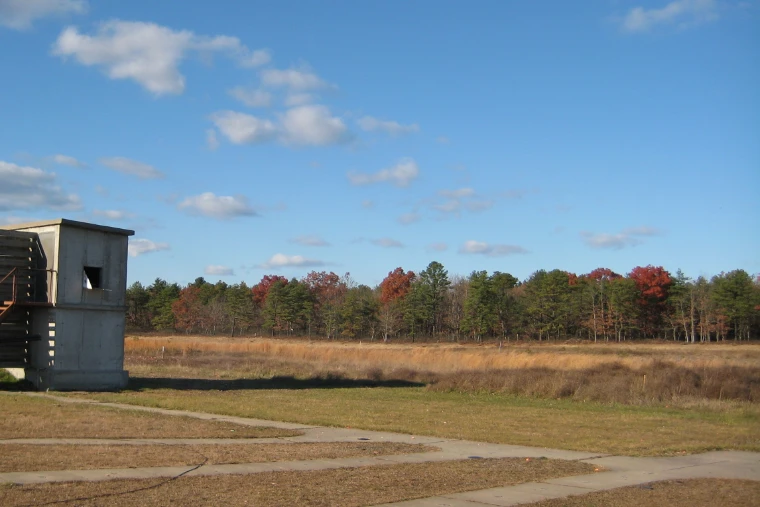
The Clay Shoot is an afternoon in late September at the Long Island Shooting Range at Brookhaven, which keeps three hundred acres for the pistol, the rifle, the shotgun and the bow, and among its clay courses has sporting clays and five-stand.
It exists for an afternoon at the clays, a game that has kept the language of the field: a target is still called a bird.
The Clay Pigeon
Shooters once shot at live birds; in America the records go back to the Sportsman Club of Cincinnati in 1831. Glass balls came next. Charles Portlock of Boston is credited with bringing them in, in 1866, and in 1877 A. H. Bogardus invented the first practical trap for them, which threw a ball at least sixty feet. Ira Paine stuffed his balls with feathers or powder, to give the look of a bird being hit. Bogardus became the wing shot champion of the world and toured with Buffalo Bill’s Wild West; in 1883 W. F. Carver beat him in nineteen matches of twenty-five.
George Ligowsky patented the clay pigeon in 1880. It was while watching youngsters skip shells across the water, the story goes, that he thought of it. His first targets were baked clay; he moved to limestone and pitch, but the name clay stuck. The clay pigeon was first seen in public at the New York State live-bird championships at Coney Island in 1880, and it gradually eased the glass ball out. Britain took up the clay in 1883, held its first championship for it in 1893, and banned live-pigeon shooting by the Captive Birds Act of 1921.
Sporting clays, “often described as ‘golf with a shotgun,’” came from the British shooting schools, which in the early 1900s took up clay targets to practise for driven game. A course is ten to fifteen stations laid round a field or along a trail through the woods, with targets thrown to fly as a bird does, and sometimes to run as a rabbit. Bob Brister introduced it to American shooters in Field & Stream in July 1980, and on 27 September that year the first sporting clays shoot in America was held at Remington’s Lordship Gun Club, in Connecticut.
Five-stand brings the same targets onto one field: five stands, six to eighteen throwers, and a menu card that gives the order, a single bird and then two pairs at each stand. The targets keep their names: the rabbit, the chandelle, the teal, which goes straight up into the air, and the incoming bird. Raymond Foreman, a Scottish-born wildlife biologist in Canada, built the game on a trap field in Alberta in 1982. It was named in 1990, when Paul Bentley suggested “How about 5-stand” and then added: “Well, it’s not very good, is it?”
The Afternoon
One afternoon, at the Long Island Shooting Range at Brookhaven, in late September.
The range has courses for trap, skeet, sporting clays, five-stand and FITASC, and hires out shotguns for the clay courses.
It is shut on Tuesdays and closes at five.
What Is Asked
Country attire. Nothing is published beyond the range’s own rules, and the Court dresses to the register of a country afternoon.
The range’s rules: eye and ear protection at all times, and closed-toe shoes.
Nobody is pitched on the stand.
The Places
The number of places and the sum are stated in the invitation.
The Court’s Driven Game Shoot follows in October.
How one becomes a member is set out under Admission.
Set down October MMXXVI