
THE OYSTER AND CHAMPAGNE EVENING
Early October · New York · An Evening · The Table
Hosted by the Court
- DatesThe 2027 dates are to follow
- WhereA private room, New York
- DressLounge suit
- AdmissionHosted by the Court
- In companyRSVP tells the Secretary that a member means to attend. Send passes the engagement’s name, its date and the address of its page to whomever the reader chooses, or, on a computer, copies the address; the Court itself sends and keeps nothing.RSVP
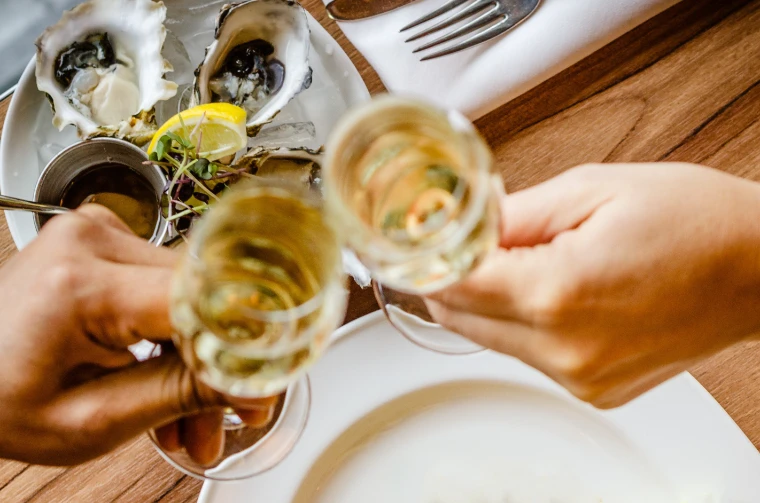
The Oyster and Champagne Evening is an evening of oysters and champagne for members, in New York in early October.
It exists because oysters are, in Mark Kurlansky’s words, “biologically identical” from Louisiana to Newfoundland, and yet “if you put them in one cove or another they will taste different.”
The Big Oyster
The oldest of the “huge piles of oyster shells” here, some “carbon-dated to as far back as 6900 B.C.”, were left by the people who lived here before the Lenape, and Pearl Street takes its name from a Lenape shell midden; the Dutch called it Parelstraat, “named for the many oysters found in the river.” Ellis, Liberty and Black Tom were the Oyster Islands of Upper New York Bay. In the colony oysters were sold on the street, and pickled with nutmeg and black pepper and sent to the other colonies and the Caribbean.
“In past centuries, if you were to say, I’m going to New York, the most likely response would be, enjoy the oysters... All five boroughs produced oysters,” Kurlansky writes. Through the nineteenth century the beds of New York Harbor were the largest source of oysters in the world, and on any day late in the century six million of them lay on barges along the waterfront. They were sold by name, as Staten Islanders, Jamaicas, Rockaways and East River, and eaten in basement oyster cellars, where the Canal Street Plan gave all you could eat for six cents, at a time when Delmonico’s charged fifty cents a berry for out-of-season strawberries. Thomas Downing, the “New York Oyster King”, opened his oyster house at 5 Broad Street in 1825, with linens, fine china and chandeliers; the City chose him to cater the Boz Ball for Charles Dickens in 1842, and his house was a stop on the Underground Railroad.
Overharvesting, disease, effluent and silt destroyed the beds. By 1916 most of the beds of the five boroughs had been closed, and in 1927 the last of them closed. The Oyster Bar under the Guastavino vaults of Grand Central opened in February 1913. Since 2015 the Billion Oyster Project has gathered spent shells from the city’s restaurants to build reefs in the harbour again.
The season is old. In 1599 Henry Buttes wrote that “The oyster is unseasonable and unwholesome in all months that have not the letter R in their name”, and New Yorkers once called August “Argust” so that they could go on eating them. The rule has its reasons: the bay oysters spawn in the warm months, and in those months they spoil more easily. October has an R.
Champagne is the Court’s choice over the Muscadet, Chablis and Sancerre that are traditionally served. Its bubbles, the house of Laurent-Perrier says, “awaken the palate and lighten the oyster’s texture”, and its acidity balances the salt; for raw oysters, the low-dosage wines, Brut Nature or Extra Brut, are the match. The oysters are served “fresh but never icy”, and once opened the first water is poured off and the oyster left to settle in its second. “If an oyster is shucked properly,” Kurlansky says, “its heart is beating as it slides down your throat.”
The Evening
One evening in early October, in a private room in New York taken for the night. The Court keeps no house of its own.
Oysters are opened to order at a table, and champagne is poured beside it.
Two or three beds are served side by side, so that they can be tasted against one another.
Nothing else is put out until later.
What Is Asked
A lounge suit. Nothing is published for a private room; Debrett’s describes the lounge suit as “a dark or grey suit, collar and tie”, for dinner in a restaurant, and the Court keeps to it.
Nobody is pitched at the table.
The Places
There are fifty places. The sum is stated in the invitation. A member may bring one guest by arrangement, and answers for them.
The Court’s White Tie Dinner follows at the end of the month.
How one becomes a member is set out under Admission.
Questions
What is the Oyster and Champagne Evening?
The Oyster and Champagne Evening is an evening in early October in a private room in New York taken for the night. Oysters are opened to order at a table with champagne poured beside it, and two or three beds are served side by side, to be tasted against one another. The 2027 date is to follow.
What does one wear to the Oyster and Champagne Evening?
A lounge suit, which Debrett’s describes as a dark or grey suit, collar and tie. Nothing is published for a private room, and the Court keeps to that.
Who may attend the Oyster and Champagne Evening?
It is for members of the Court, by the Court’s invitation. A member may bring one guest by arrangement, and answers for them. There are fifty places, and nobody is pitched at the table. How one becomes a member is set out under Admission.
- Photograph, Emrys Horton for NwongPR (NwongPR) · CC BY-ND 2.0
Set down October MMXXVI
The Gazette: the engagements of the coming weeks, by email, once a week.