THE ROLEX MIDDLE SEA RACE
Mid to Late October · Grand Harbour, Valletta · A Week · Since 1968
2027: dates to follow
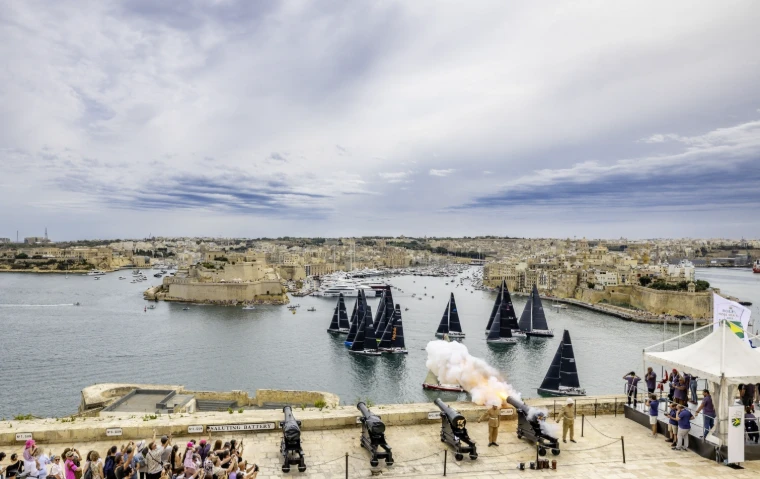
The Rolex Middle Sea Race is an offshore race of some six hundred and six nautical miles from Grand Harbour, Valletta, anticlockwise round Sicily and back to Malta, started at eleven on a Saturday in October: round Capo Passero, through the Strait of Messina, past Stromboli, west to Favignana, south to Pantelleria and Lampedusa, and home through the Comino Channel to finish at the entrance to Marsamxett Harbour. The Royal Malta Yacht Club runs it, and the fleet goes from boats of thirty feet to boats of over a hundred.
The first prize giving was in black tie, and its guest of honour was Sir Francis Chichester, lately home from sailing alone round the world.
Two Volcanoes
The race came out of a rivalry between two British yachtsmen living in Malta, Alan Green and Jimmy White, and two Maltese sailors of the Royal Malta Yacht Club, Paul and John Ripard. Green and White first proposed a race from Malta to Syracuse one year and back the next. Paul Ripard insisted that it should start and finish in Malta, and the course became a voyage round Sicily, taking in Lampedusa, Pantelleria and the Egadi and Aeolian islands. At around six hundred and ten miles it was close to the Fastnet, then six hundred and eight. Green counted its gifts, among them the only tidal strait in the Mediterranean and “the warmth of the water in autumn”, and wrote: “In matching the length of the Fastnet, Bermuda, and Sydney Hobart races, I was sure we had a winning formula.”
The club backed it in 1968 with six months’ notice. Green ran it on condition that he had complete authority and could sail in it. Howitzers of the Royal Malta Artillery marked the start, Fort Manoel in Marsamxett Harbour held the start and the race control, the RAF flew a reconnaissance aircraft every day, and British and Italian warships helped with the positions. The first races went clockwise, to Lampedusa first. There were eight entries. Stormvogel was first home, and the smallest boat, John Ripard’s Swan 36 Josian, won overall, with a young Arthur Podesta in the crew. The trophy, in bronze, was designed by Emvin Cremona, the Maltese artist known for his postage stamps.
After 1983 the race lapsed for thirteen years, and it was sailed again in 1996 with twenty-one yachts. Rolex took the title in 2002, when forty-two started; the record had been thirty-four, in 1974. In 2009 the start moved to Grand Harbour, and the club to Ta’ Xbiex. The fleet passed a hundred for the first time in 2014, and in 2018, for the fiftieth anniversary, a record hundred and thirty boats came from twenty-nine countries.
Arthur Podesta sailed every race from 1968 to 2014. His children Aaron, Christoph and Maya won it overall in 2019 and 2020 with Elusive 2, the first to win twice running since Nita IV in 1980.
The Course
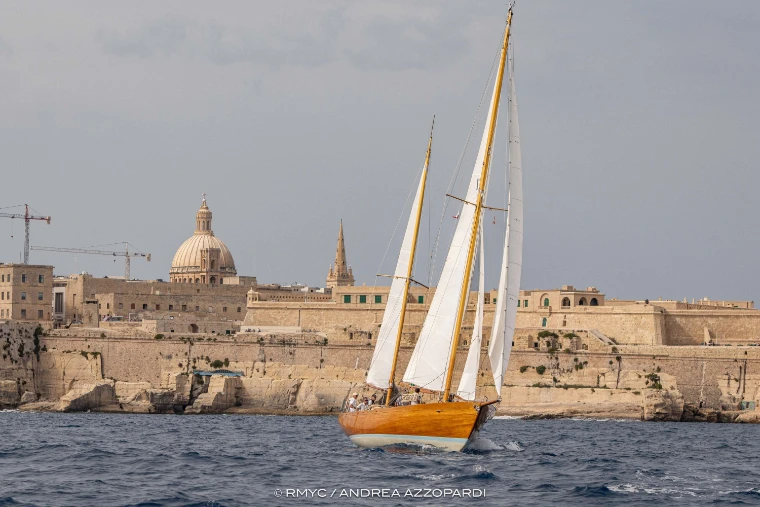
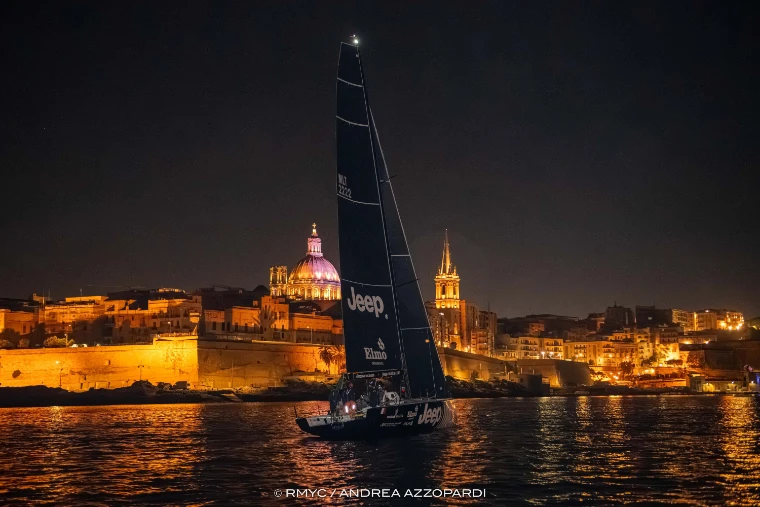
The week begins with registration on the Monday. A coastal race is sailed on the Wednesday, there is a crew party on the Thursday, free to all who sail, and the skippers are briefed on the Friday. On the Saturday the boats go off in a series of starts across a line in the middle of Grand Harbour, from the Saluting Battery beneath the Upper Barrakka Gardens to Fort St Angelo in Birgu, to the sound of the battery’s guns. One skipper in 2025 remembered “crossing the line under the booming cannons with those massive crowds watching from the historic bastions”.
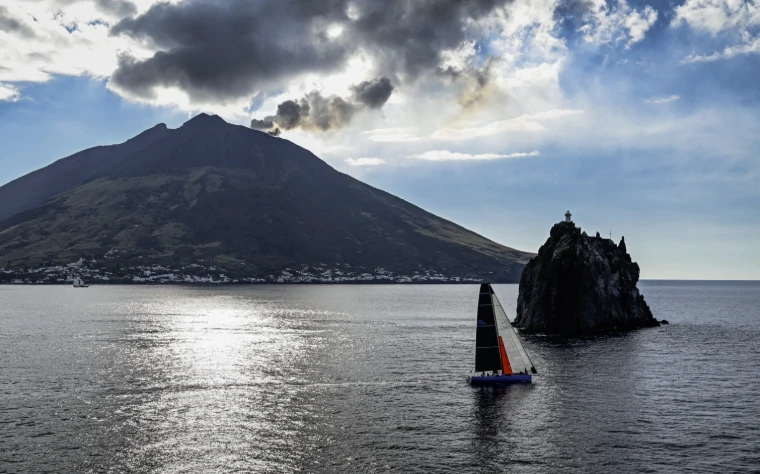
Capo Passero comes at fifty-five miles, the Strait of Messina at a hundred and fifty-three and Stromboli at a hundred and eighty-eight. The volcano has been in nearly continuous eruption for two thousand years. The same skipper passed it in the dark and saw “the lava glowing high above the horizon like a lighthouse for Titans”. Favignana follows at three hundred and thirty-eight miles, Pantelleria at four hundred and twelve, Lampedusa at five hundred and two, and Comino at five hundred and ninety-six.
The quickest boats are home in a little over two days, and most take three or four; the slowest are still at sea the following week. In the storm of 2007 twenty-two boats retired within a day and only seventeen finished, while George David’s Rambler set a record of 47 hours 55 minutes that stood for fourteen years. Comanche won overall in 2021 and set the monohull record, 40 hours 17 minutes. The prize goes on handicap: in 2023 Bullitt, of ninety-three feet, beat Red Ruby, a thirty-three-footer sailed by two, by twenty-four seconds. Monohulls race under IRC and ORC and the multihulls under MOCRA, and the race counts towards the season’s points of the Royal Ocean Racing Club.
The 2026 race, the forty-seventh, marks thirty years since the revival. The boats start on Saturday 17 October, and the prizes are given on 24 October in the Sacra Infermeria. Balthasar, Louis Balcaen’s Belgian boat, returns to defend her win of 2025; Red Ruby comes from the United States for the third time, Lee Satariano sails Artie, the winner of 2011 and 2014, in his seventeenth race, and the Swan 47 Sassafras, of 1977, comes from Canada.
What to Know
The race starts on a Saturday in mid to late October, and the prizes are given on the Saturday after. The 2027 dates have not been announced.
There are no tickets. The start is watched for nothing from the waterfront and the fortifications round Grand Harbour, and is broadcast live from half past ten. The Upper Barrakka Gardens look straight down on the line; the Lower Barrakka and the waterfront at Birgu are quieter. A satellite tracker follows every boat from the start.
Yachting attire on the bastions and at the club; a lounge suit for the prize giving. Nothing is published, and the first prize giving, in 1968, was in black tie.
Malta International Airport, at Luqa, south-west of Valletta, is the island’s only international airport. The Grand Hotel Excelsior, with its own marina looking over Marsamxett Harbour and Manoel Island, has housed the race’s guests for years. In 2026 the prize giving falls on the night of Junior Eurovision at Ta’ Qali: book early.
The mistake is to take the first boat home for the winner. The overall prize is worked out on handicap, and the first boat home usually does not win.
The Court
The Rolex Middle Sea Race is not the Court’s own. A place above the line for the start, and at the prize giving in the Sacra Infermeria, is sought on a member’s behalf, and the Court arranges the whole of it: getting there, where to stay in Valletta, and the table afterward. Frieze London and Frieze Masters fall in the same week.
How one becomes a member is set out under Admission.
Set down October MMXXVI