THE SQUASH TOURNAMENT
Mid September · Manhattan · An Evening · Hosted by the Court
2027: dates to follow
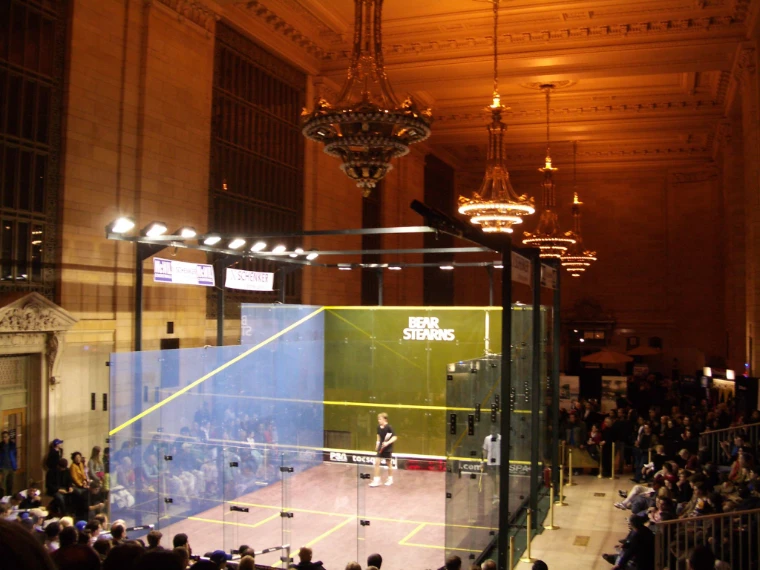
The Squash Tournament is one evening in mid-September on courts the Court books privately at a squash club in Manhattan: a knockout among members, seeded by the committee and played to its end the same night, with a marker calling each game and dinner afterwards.
It exists because squash in New York grew up in the clubs, as a game played among members, and an evening’s draw keeps it there.
The Game in New York
Squash came out of racquets, which began among the inmates of the Fleet Prison in London early in the eighteenth century. Harrow opened a new complex of racquets and fives courts on 20 January 1865, and its boys played “baby racquets” on the fives courts. The first squash court in North America was at St. Paul’s School, in New Hampshire, in 1884. The United States Squash Racquets Association was founded in 1904, and ran its first men’s national championship in 1907.
In New York the game belonged to the clubs. The Racquet and Tennis Club built its house at 370 Park Avenue to designs by McKim, Mead and White between December 1916 and April 1918, with four singles squash courts and a hardball doubles court beside its court tennis and racquets courts; in February 1923 it held the first collegiate squash match ever played, which Harvard won against Yale by four to one. The University Club, at 1 West 54th Street, keeps five singles courts and a doubles court on its tenth floor. In 1924 the University Club, the Rockaway Hunting Club and the Montclair Athletic Club founded NY Squash, and the Racquet and Tennis Club and the Harvard Club of New York joined it that year.
The American game was hardball: a harder rubber ball that plays faster, on a singles court eighteen and a half feet wide against the international twenty-one, a width fixed in 1924. By the mid-1990s most players in North America had gone over to the international game, and in 1996 eighty per cent of the squash balls sold in the United States were international balls. Hardball singles has faded; hardball doubles, in the words of one account, “continues to thrive.”
A match has a marker. The marker announces the match, introduces each game and announces the result, calls “fault,” “down,” “out,” “not up” or “stop,” and calls the score with the server’s score first. A referee rules on every request for a let and every appeal against the marker’s call, and the referee’s decision is final. Games are to eleven points, played on from ten-all to a lead of two, and a match is normally the best of five.
The Evening
One evening, on courts booked privately at a squash club in Manhattan. The Court has no courts of its own.
The draw is a knockout among members, seeded by the committee, and it is played to the last match the same night.
Matches are best of five, and a marker calls each game.
The beaten players go into a losing bracket, and keep playing until one name is left.
Dinner follows.
What Is Asked
Tennis whites. Nothing is published that asks for white on a squash court; whites are the Court’s choice.
The marker calls the game. An appeal goes to the referee, whose decision is final.
Nobody is pitched at dinner.
The Places
The number of places and the sum are stated in the invitation.
The Court’s other draw is The Grass Court Tennis Tournament, in late June.
How one becomes a member is set out under Admission.
Set down October MMXXVI