
AFTERNOON TEA AT THE LONG ISLAND MANSION
Mid to Late August · The North Shore, Long Island · An Afternoon · Hosted by the Court
2027: dates to follow
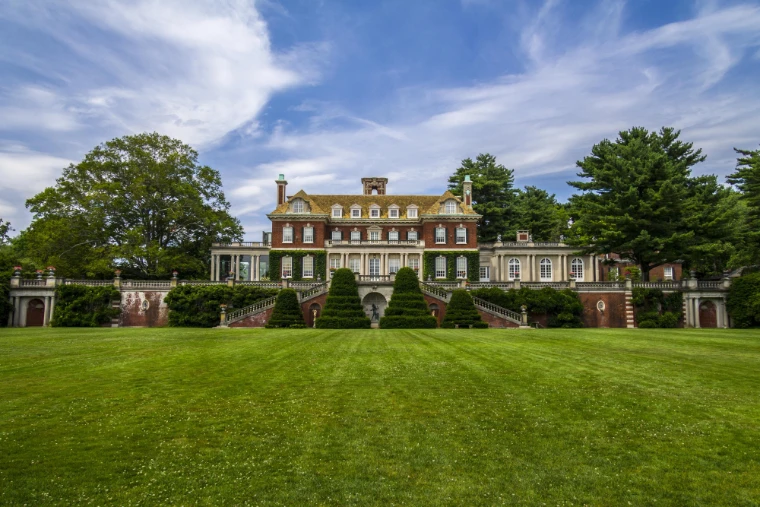
Afternoon Tea at the Long Island Mansion is an afternoon in mid to late August at a house on the North Shore, for twelve members, each bringing one guest: tea taken in the drawing room or on the terrace as the weather allows, served properly, and the house seen afterwards by a party small enough to see it.
It exists because, as Emily Post wrote in 1922, “The garden party is merely an afternoon tea out of doors”, and the North Shore still has the houses and the terraces for both.
Tea on the Gold Coast
The North Shore of Long Island “exploded into affluence at the turn of the 20th century, earning it the nickname the Gold Coast.” Beginning in the early 1890s, more than five hundred houses were built on some seventy square miles of it, and about two hundred survive. The Vanderbilts, the Astors, the Whitneys, J. P. Morgan, F. W. Woolworth and the Pratts had estates there, and the architects and landscape designers associated with the estates included Stanford White, John Russell Pope, Guy Lowell, Carrère and Hastings and the Olmsted Brothers.
The estates had formal gardens, greenhouses, stables, pools and tennis courts. “Polo, fox hunting, yachting, golf and tennis formed part of the Gold Coast’s recreational culture”, and clubs grew up around it: the Seawanhaka Corinthian Yacht Club, of 1871; the Meadow Brook Club, incorporated in 1881; Piping Rock, of 1911; and The Creek, of 1923. The Fitzgeralds moved to Great Neck in October 1922, and The Great Gatsby, published in 1925, drew on “the riotous parties he attended on Long Island’s North Shore in 1922”. Its West Egg is drawn from Kings Point and its East Egg from Sands Point.
Afternoon tea is older than the houses. Anna Maria Russell, seventh Duchess of Bedford and “one of Queen Victoria’s ladies-in-waiting”, is usually credited with it. Lunch was at midday and dinner was moving later, and at about five she felt a “sinking feeling”; she “requested that some tea, bread and butter and cake was brought to her room in the late afternoon.” She later invited friends to join her, the custom “soon spread across Britain”, and by the 1880s the Queen held official tea receptions at her palaces. It was not entirely new: Madame de Sévigné had written of “thé de cinq heures”, and in 1763 the ladies of Harrogate were serving “afternoon tea or coffee”.
By the 1860s and 1870s it had reached the middle class. High tea was a heartier working-class meal, and afternoon tea was also called low tea. The tea reception was considered the “least formal, most friendly and enjoyable of all entertainments given at home”, and half an hour was enough for a guest to stay. Tea gowns, loose and often of chiffon, were worn at home teas from 1875 to the 1920s. Emily Post held that there is “not the slightest difference” in the service of the tea table “whether in the tiny bandbox house of the newest bride, or in the drawing-room of Mrs. Worldly of Great Estates”, and that “A cloth must always be first placed on the table, before putting down the tray.”
The Afternoon
Twelve members, each with one guest, at one house.
The party arrives at four. Tea is taken in the drawing room, or on the terrace when the weather allows; the decision is made that morning.
The service is proper: a cloth laid first, everything brought on a tray, the tea poured at the table, with sandwiches, bread and butter and cake.
After tea the owner, or someone who knows the house, takes the party through it and out into the garden.
The afternoon ends at half past six, and the cars are at the door.
What Is Asked
A lounge suit; summer dresses. Nothing is published for a private house, and the Court dresses to the register of a drawing room.
Each member brings one guest, named to the Court a week before.
Telephones stay in pockets. Photographs only with the owner’s leave.
The house’s address is not passed on.
Nobody is pitched at tea.
The Places
Twelve members, and twelve guests. It is as many as a drawing room will seat at tea, and as many as can be shown a house without crowding it.
Members are written to in June, and told the house a week before.
The sum is stated in the invitation and covers tea, the cars from Manhattan and the Court’s arrangements.
The Court’s Summer Table, in New York, follows at the end of the month.
How one becomes a member is set out under Admission.
Set down October MMXXVI