
THE SUMMER TABLE
Late August · New York · An Evening · Hosted by the Court
2027: dates to follow
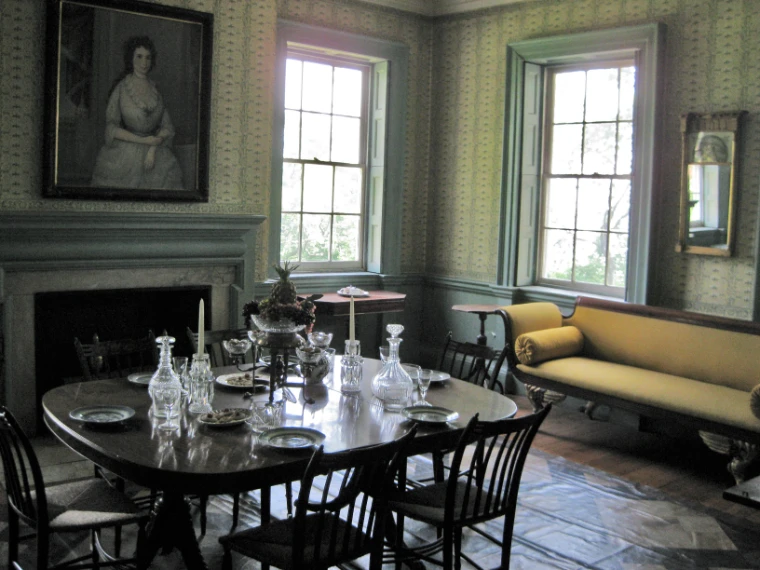
The Summer Table is one dinner at the end of the summer, in a private room the Court takes in New York for the night: black tie, a single table laid for the full membership, places drawn rather than chosen, and one toast at the end of dinner with no speeches after it.
It exists so that the whole of the Court sits down together once a year, in an order nobody chose.
The Private Room
Until the Waldorf, one account says, “polite society did not gather in public places, especially hotels.” It dined at home, or in a private room.
Delmonico’s had such rooms. It opened in 1827 at 23 William Street, kept by the Swiss-Italian brothers Giovanni and Pietro Delmonico, who were joined in 1831 by their nephew Lorenzo; after the Great Fire it moved to 56 Beaver Street, opened in August 1837 behind entrance columns New Yorkers were told had come from Pompeii. It hired Charles Ranhofer as its chef in 1862, and between 1865 and 1888 ran four restaurants at once. Of its private rooms, one history says: “Boss Tweed and his henchmen spent many a pleasant evening plundering New York City in one of Delmonico’s private dining rooms”. Private rooms in general were also, for a time, how a woman dined out without a man: “Private dining rooms where solitary women could eat out of sight were the norm, and only for the most elite women.” On 20 April 1868 the dozen women of Jane Cunningham Croly’s club, Sorosis, lunched at Delmonico’s without men, with Lorenzo Delmonico as their host.
Society’s balls were held there too. In 1872 Ward McAllister formed the Patriarchs, twenty-five gentlemen of New York society, each of whom could invite four ladies and five gentlemen to the Patriarchs’ Ball, and the first ball was held at Delmonico’s. McAllister said there were “only 400 people in fashionable New York Society”; the newspapers called him “Mr. Make-a-Lister”, and the Times printed the list on 16 February 1892.
Louis Sherry opened his first restaurant in about 1880, at 38th Street and Sixth Avenue, with $1,300 saved, and won the Four Hundred with his “dainty decorations” and “novelties of service”. In March 1903 C. K. G. Billings gave a dinner for thirty-six friends in Sherry’s fourth-floor ballroom, on horseback: the floor was turfed, the horses came up by the freight elevator, silver trays were fixed to the saddles, the champagne was drunk through rubber tubes from iced bottles in the saddlebags, and the waiters were dressed as grooms. Sherry closed in 1919, with Prohibition, and the family’s last Delmonico’s closed in 1923. Delmonico’s reopened at 56 Beaver Street on 18 September 2023.
The Table
At a formal dinner, someone has long decided where everyone sits. In 1791 Trusler, in The Honours of the Table, wrote that “both men and women have sat above each other, according to the rank they bear in life.” Victorian couples went down to dinner “in order of precedence”. In 1922 Emily Post’s Mrs. Worldly laid out her place cards “very much as though playing solitaire”, trying “to seat side by side those congenial to each other.”
The Court draws places instead. It knows of no older table seated by lot, and that is the point: drawn places are its deliberate break with seating by rank, and with seating by a hostess’s choice. Nobody is put above anybody, and nobody is put next to anybody on purpose.
A toast is, in one definition, “a ritual during which a drink is taken as an expression of honour or goodwill.” The loyal toast is given by the host, standing, “without any other words or music”, and there is sometimes a tradition of smashing the glass “so that no lesser toast can be made with it.” The Court keeps one toast in that spirit, and nothing is said after it.
One table, in a private room taken for the night, laid for every member.
Members arrive from half past seven and take a drink standing.
At the door each member draws a card, and the card gives the place. The place cards at the table are plain, with the name and nothing else.
Dinner is at eight.
After the last course, the member who drew the head of the table stands and gives the toast, to the Court. Nobody speaks after it.
The table is cleared at eleven, and the room stays open.
What Is Asked
Black tie.
Be seated by eight. The Court sits down whether or not everyone is there.
The place drawn is the place taken. Cards are not exchanged.
One toast. Nobody rises to speak after it, and glasses are not raised to anything else.
Telephones stay in pockets.
Nobody is pitched at the table.
The Places
Every member. The table is laid for the full membership, and the room is taken to seat it.
The table is for members; there are no guests.
Members are written to in June.
The sum is stated in the invitation and covers the room, dinner and the wine.
The Court’s Afternoon Tea at the Long Island Mansion is held in the same weeks.
How one becomes a member is set out under Admission.
Set down October MMXXVI