FORMULA 1 BELGIAN GRAND PRIX
Late July · Spa-Francorchamps, the Ardennes · Three Days · Since 1925
2027: 23 to 25 July
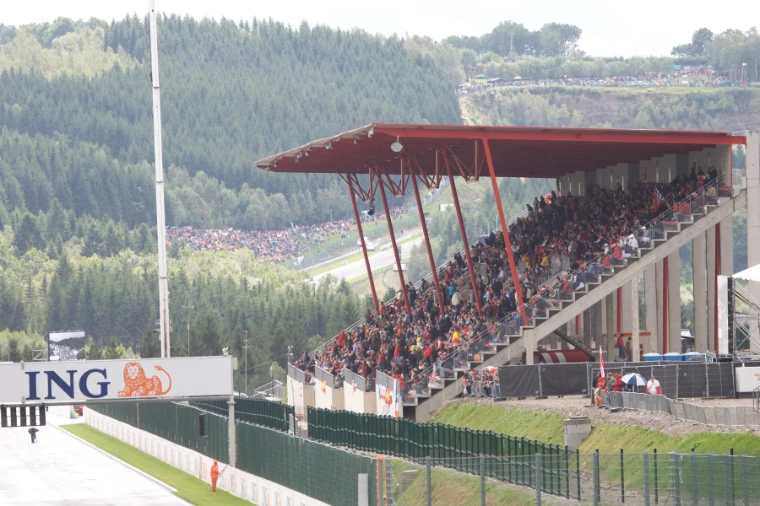
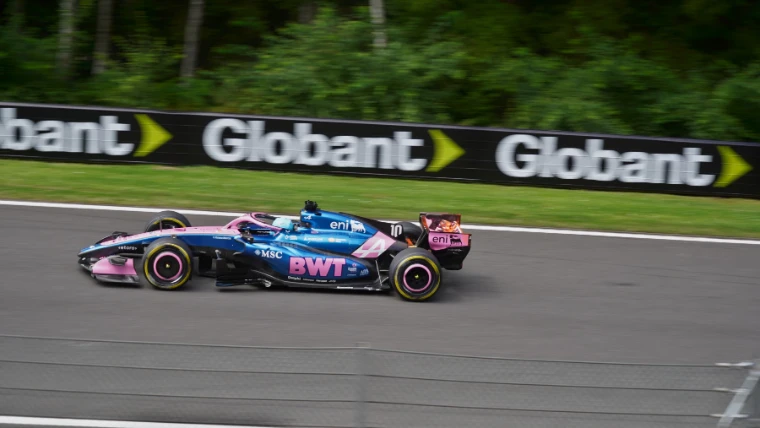
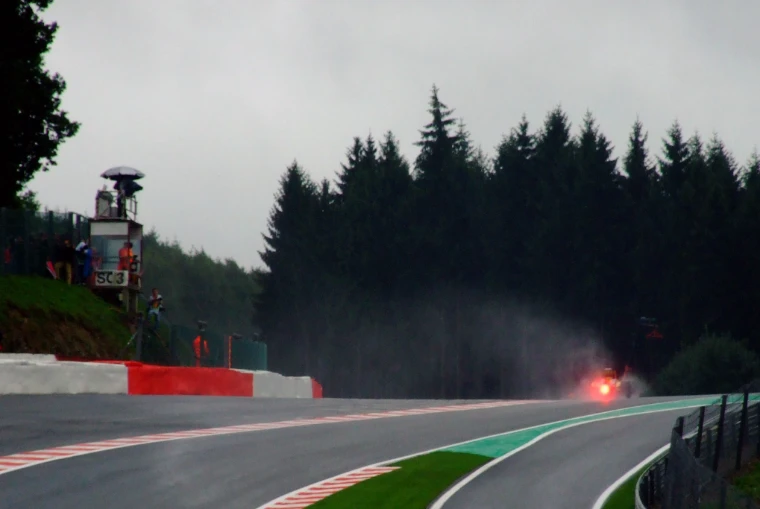
The Belgian Grand Prix is a Formula One weekend in late July at Spa-Francorchamps, in the hills of the Ardennes: seven kilometres of road through the forest, the longest lap in the championship, with practice on the Friday, qualifying on the Saturday and the race on the Sunday afternoon. The weather is the famous part. It can be bright on one side of the circuit and raining on the other, and at one time it rained at the race for twenty years running.
At the foot of the hill the cars cross a stream called Eau Rouge, for the iron in its stones, and climb Raidillon blind at more than three hundred kilometres an hour. “…you cannot see the exit,” Fernando Alonso has said, “and as you come over the crest, you don’t know where you will land.”
The Old Circuit
In 1920 Jules de Thier, who owned the Liège newspaper La Meuse, met the burgomaster of Francorchamps and a racing driver at a hotel in the village, and chose a triangle of public roads between Francorchamps, Malmedy and Stavelot. The first motor race, set for August 1921, was replaced by one for motorcycles when only one car entered. The first Belgian Grand Prix was run there in 1925, and won by Antonio Ascari for Alfa Romeo.
The old circuit was some fourteen kilometres of ordinary road, through villages and farmland, the fastest road circuit in Europe; most of it was taken at more than 290 kilometres an hour. Jackie Stewart called it “ferocious as a tiger”. In the rain of 1966 he crashed at the Masta kink and lay trapped in his car, soaked in fuel, until Graham Hill and Bob Bondurant freed him with a spectator’s tools; there was no doctor on hand, and the ambulance got lost on the way to Liège. He spent the rest of his career fighting for the safety of drivers, and in 1969 the race was called off when the owners would not pay for the work he and the other drivers asked.
The circuit was cut to seven kilometres in 1979, keeping Eau Rouge and the hills, and the Grand Prix came back to it in 1983. Michael Schumacher made his debut there in 1991 and won the race six times, more than anyone; Ayrton Senna and Lewis Hamilton won it five times each. Spa is to hold the race in 2026, 2027, 2029 and 2031, sharing the years between with Barcelona.
The Weekend
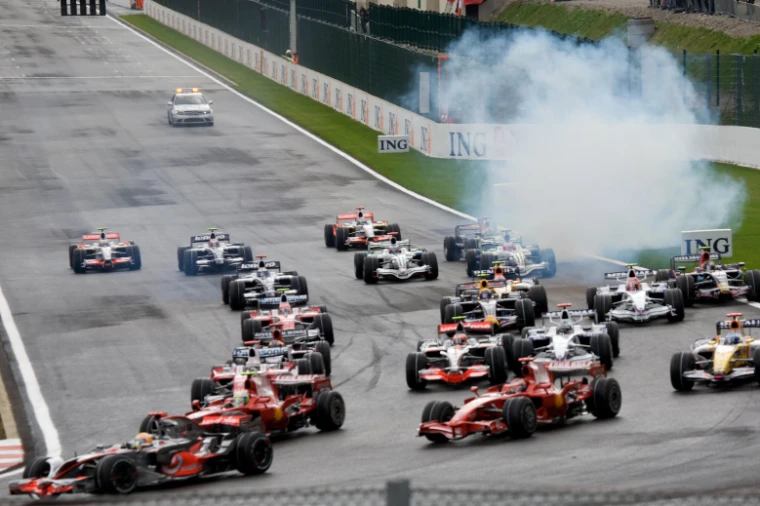
Friday is practice, two sessions. Saturday has a last practice and qualifying in the afternoon. The race starts at three on Sunday: forty-four laps, from the La Source hairpin down to Eau Rouge, up the Kemmel straight to Les Combes, round Pouhon and back through Blanchimont to the chicane. Formula 2, Formula 3 and the Porsche Supercup race in between.
The stands and banks are spread through the woods. The Gold grandstands look over the start, La Source and Eau Rouge; the Silver ones over the corners further out; the Bronze ticket gives the run of the banks.
In 2026, on 19 July, Kimi Antonelli won for Mercedes from pole, from Charles Leclerc and Max Verstappen, after the rain that had been forecast on the formation lap held off.
What to Know
It runs from a Friday to a Sunday in late July: in 2027, from 23 to 25 July. There is no race at Spa in 2028.
Weekend tickets cover all three days: about €215 to wander the banks, €500 or so for a seat in a Silver stand, about €740 to €950 in the Gold, more for the premium seats, and more again for the boxes over Raidillon and the Paddock Club.
No dress code is given. Bring a coat and an umbrella; Formula One’s own guide warns of four seasons in a day.
The circuit is in Francorchamps, some eight kilometres from Spa itself, half an hour from Liège and about two hours from Brussels airport. Trains run to Verviers, with a shuttle to the circuit, and coaches run on race days from Brussels, Liège, Cologne and elsewhere. Stay in Spa, an old spa town among the Great Spa Towns of Europe, or in Stavelot or Malmedy.
The mistake is to plan to leave on the Sunday night. The traffic after the race is notorious, and it can take hours to get out of the car parks; fly home on the Monday.
The Court
The Belgian Grand Prix is not the Court’s own. A box over Raidillon, a place in the Paddock Club or seats in the Gold stands are sought on a member’s behalf, and the Court arranges the whole of it: getting there, by road or by air, where to stay in Spa or the villages round it, and the table afterward.
How one becomes a member is set out under Admission.
Set down October MMXXVI