FORMULA 1 DUTCH GRAND PRIX
Late August · Circuit Zandvoort, Zandvoort · Three Days · Since 1948
Not held in 2027
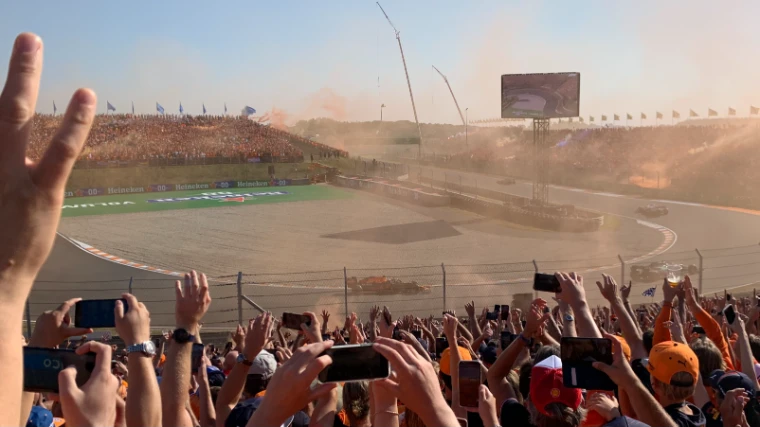
The Dutch Grand Prix was a round of the Formula One World Championship, run over three days, in 2026 at the end of August, at Circuit Zandvoort, a track in the dunes north of Zandvoort, near the North Sea and thirty-five kilometres west of Amsterdam: practice on the Friday, qualifying on the Saturday and the race on the Sunday. It was held from 1950 through 1985, and again from 2021 to 2026. The last was run on 23 August 2026.
In its last years the grandstands were “packed with thousands of fans in head-to-toe orange”, like “a football away crowd, with orange shirts, wigs and flags aplenty.”
The Dunes
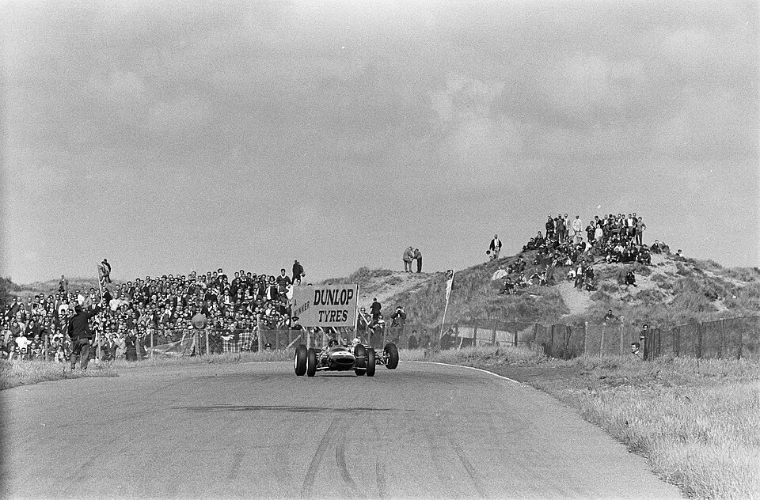
The road came before the circuit. During the German occupation a straight road was built through the dunes for the Germans to hold victory parades, and it was later joined to the roads that served the coastal defences. The story goes that the town’s mayor struck a bargain with the occupier, to spare the townspeople forced labour. In 1947 the government halted the work, because the whole bricks in the rubble beneath the road were wanted for reconstruction; the municipality enlisted Prince Bernhard, and the bricks were bought for twenty thousand guilders.
Sammy Davis, who had won at Le Mans in 1927, was brought in to advise on the design in July 1946, though the old roads decided much of the layout. The first race was run on 7 August 1948 and won by Prince Bira of Thailand in an old Maserati, ahead of Tony Rolt and Reg Parnell. In 1950 it took the name Grote Prijs van Nederland, the Dutch Grand Prix. John Hugenholtz, chairman of the Dutch racing club, became the circuit’s first director in 1949 and ran it until 1974. He is often credited with its design, and did not design it; he went on to lay out Suzuka, Zolder, the Motodrom at Hockenheim and Jarama.
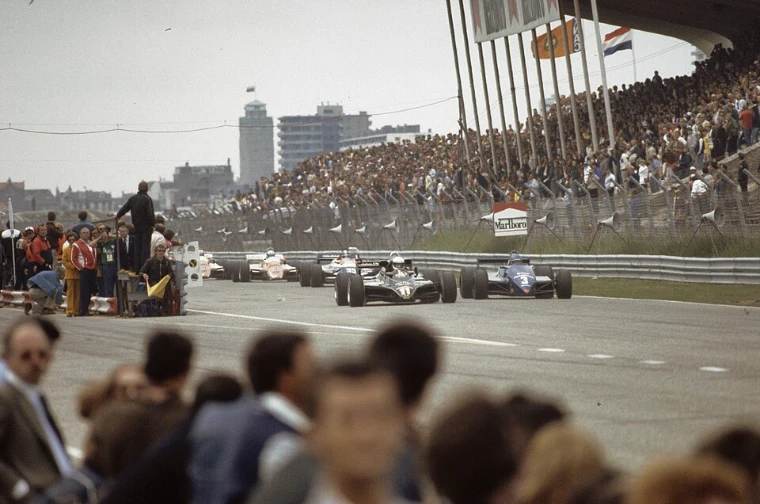
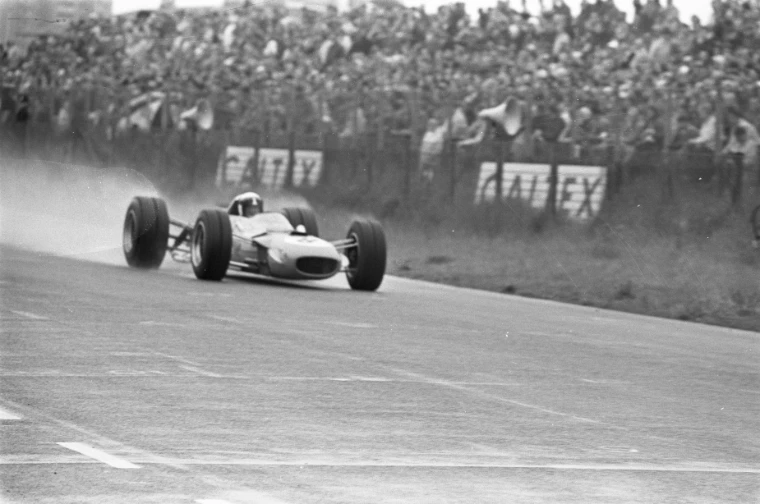
Louis Rosier won the Grands Prix of 1950 and 1951, when they did not count for the championship; from 1952 they did, and Alberto Ascari won that year and the next. There was no race in 1954, 1956 or 1957, for want of money, and none in 1972, when the drivers refused to race on a circuit grown out of date. The Lotus 49, with the Cosworth DFV, won on its first appearance here in 1967, with Jim Clark, who won at Zandvoort four times, more than anyone. Piers Courage was killed here in 1970, and Roger Williamson in 1973, when David Purley, who tried to save him, was awarded the George Medal. In 1979 Gilles Villeneuve drove a lap on three wheels.
The last race of the old era was run on 25 August 1985 and won by Niki Lauda, the twenty-fifth and final win of his career. The company that ran the circuit went out of business, and in 1987 about half the track was sold to a developer of bungalow parks.
The Return
On 14 May 2019 Zandvoort was confirmed for the following season. The race of 2020 was lost to COVID, and Formula One came back on 5 September 2021, thirty-six years after Lauda’s win. Jarno Zaffelli reworked the track and banked two of its corners, the Hugenholtzbocht at turn three and the Arie Luyendijkbocht at turn fourteen, at some eighteen or nineteen degrees. The Luyendijkbocht, the fastest corner, is named for Arie Luyendyk, the Flying Dutchman, who won the Indianapolis 500 in 1990 and 1997.
Tickets for 2021 sold out within hours, and Max Verstappen won, as he did in 2022 and 2023, each time from pole position. Lando Norris won in 2024 and Oscar Piastri in 2025. It sold out every year, with more than a hundred thousand people a day, and it ran without any government support: its promoter, Robert van Overdijk, said that it needed “a full house on all three days simply to break even.” Ninety-eight per cent came by train, by bicycle or on foot.
Hospitality ran to the Paddock Club, a Corporate Lounge and Race Home. The race was seventy-two laps, 306.587 kilometres. The dunes give the track its rises and falls and its wind, and the blown sand made the grip uncertain and wore the cars; Gary Anderson remembered taping a nylon stocking over an air intake for the start.
On 4 December 2024 Formula One announced a last year, 2026, after which the promoter would not continue, choosing to go out on a high. Stefano Domenicali said the Dutch team had “raised the bar for European Grands Prix”.
The last was run from 21 to 23 August 2026, as the Formula 1 Heineken Dutch Grand Prix, with the first sprint held on Dutch soil; George Russell won the sprint, from Charles Leclerc and Norris. Martin Garrix performed and Davina Michelle sang the national anthem before the race at three o’clock on the Sunday, and Verstappen wore a helmet in the blue and white of Delftware. He crashed on the first lap and was unhurt. Norris, from pole, passed Kimi Antonelli and Lewis Hamilton on lap fifty-four and won from Antonelli and Russell, his second win at Zandvoort. “Yesterday I said we needed to put on a bit of a show for everyone for the final race here,” he said.
What to Know
There is no race in 2027. The Dutch Grand Prix is not on the Formula One calendar, and the 2026 edition was the last. The circuit goes on with other racing, and a Formula E race at Zandvoort is listed for 2027.
In 2026 a three-day ticket cost from €318 to €875, and a Sunday from €195 to €560. The Saturday and Sunday sold out.
A lounge suit. Nothing was published; that was the Court’s choice for the Paddock Club.
The town and its neighbours were closed to cars and motorcycles for the weekend. Twelve trains an hour ran from Amsterdam Centraal to Zandvoort aan Zee, a fifteen-minute walk from the circuit along the promenade; there were park-and-ride buses from Amsterdam, Hoofddorp and Amstelveen, and bicycles through the dunes, about half an hour. The promoter advised arriving before nine. One stayed at the beach hotels of Zandvoort, in Haarlem or in Amsterdam.
The mistake was to leave with everyone else. The waits at the station were long, and the promoter’s advice was to stay on in the town and travel later.
The Court
The Dutch Grand Prix was not the Court’s own. The Court’s place for it was the Paddock Club, sought on a member’s behalf, and the Court arranged the whole of it: getting there, where to stay in Zandvoort or Amsterdam, and the table afterward.
How one becomes a member is set out under Admission.
Set down October MMXXVI