
FORMULA 1 SINGAPORE GRAND PRIX
Early October · Marina Bay, Singapore · Three Days · Since 2008
2027: 8 to 10 October
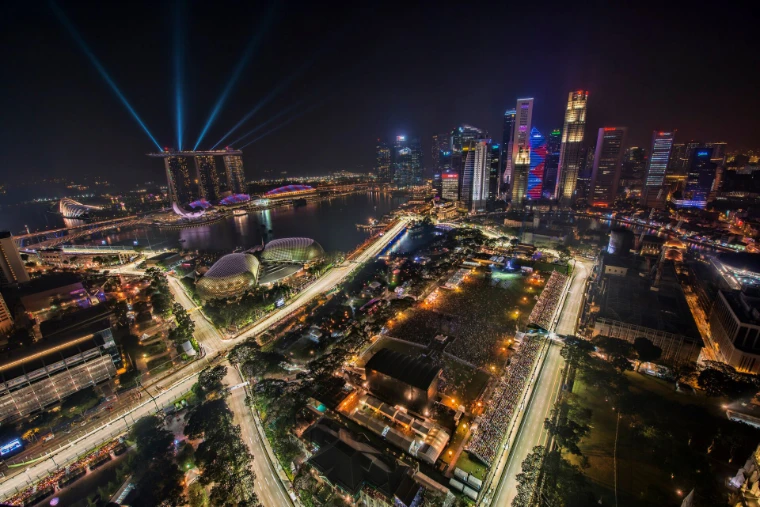
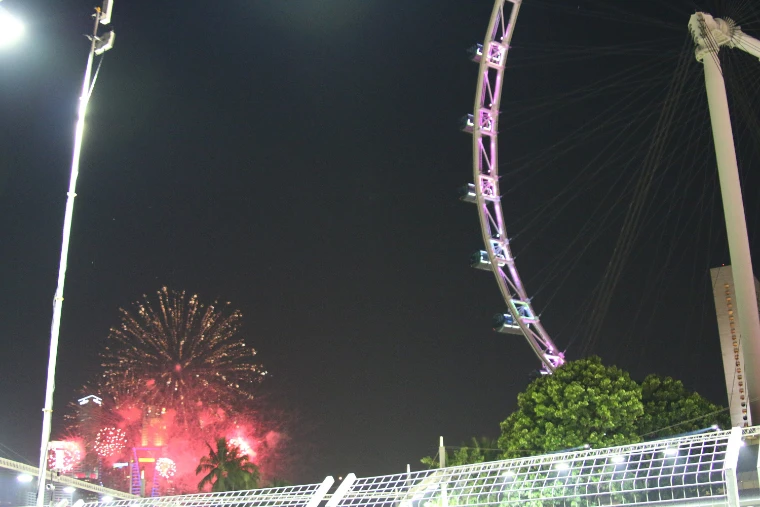
The Singapore Grand Prix is three days of Formula One in early October on the public streets around Marina Bay, run at night under floodlights: practice from the Friday evening, and the race at eight on the Sunday night, sixty-two laps of a circuit of 4.927 kilometres that passes the Padang, crosses Anderson Bridge and runs beneath the Singapore Flyer. In 2008 it was the first race in the history of Formula One to be run at night.
Its lights are put up from scratch every year. Of all Formula One’s night races, it is the only one lit by a temporary installation.
Thomson Road
Singapore’s first Grand Prix was run in 1961, as the Orient Year Grand Prix, at the Thomson Road circuit. It took the name of the Singapore Grand Prix in 1966, shortly after Singapore became a sovereign country, and ran at Thomson Road until 1973. Then it stopped: traffic, the danger of the track, the closing of the roads and fatal accidents in the races of 1972 and 1973 have all been given as reasons.
It came back in 2008, on a five-year agreement between Singapore GP, the Singapore Tourism Board and Bernie Ecclestone. The government paid sixty per cent of the bill, ninety million Singapore dollars of a hundred and fifty. About a hundred and ten thousand tickets were sold for the first race, and every one of them went. It was the fifteenth round of the championship and the eight hundredth World Championship race, and it was run at night partly so that it could be seen live at a reasonable hour outside Asia. The plan of the circuit was drawn by Herman Tilke and refined by KBR, and it was the first street circuit in Asia designed for Formula One.
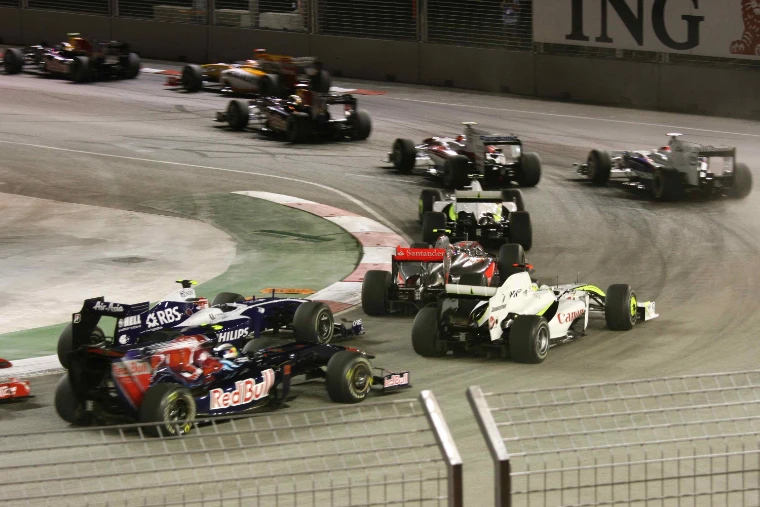
That first race left two stories. Felipe Massa took pole for Ferrari and led until he was sent away from a pit stop with the fuel hose still attached, and fell to last. Fernando Alonso won for Renault, and a year later it came out that his teammate, Nelson Piquet Jr., had been ordered to crash, bringing out the safety car at a moment chosen to suit Alonso.
In 2010 Heikki Kovalainen jumped from his burning Lotus, borrowed a fire extinguisher and put the fire out himself. In 2015 a spectator walked onto the track by Anderson Bridge, and Sebastian Vettel called him “crazy”. In 2017 Vettel, on pole, collided with Räikkönen and Verstappen at the first corner, and Lewis Hamilton won from fifth. In 2019 Vettel won his last race there, with Ferrari first and second. It was not held in 2020 or 2021. Vettel has won it five times, and Ferrari and Mercedes five times each. Singapore Airlines has given the race its name since 2014, and it is on the calendar until 2028.
The Lights
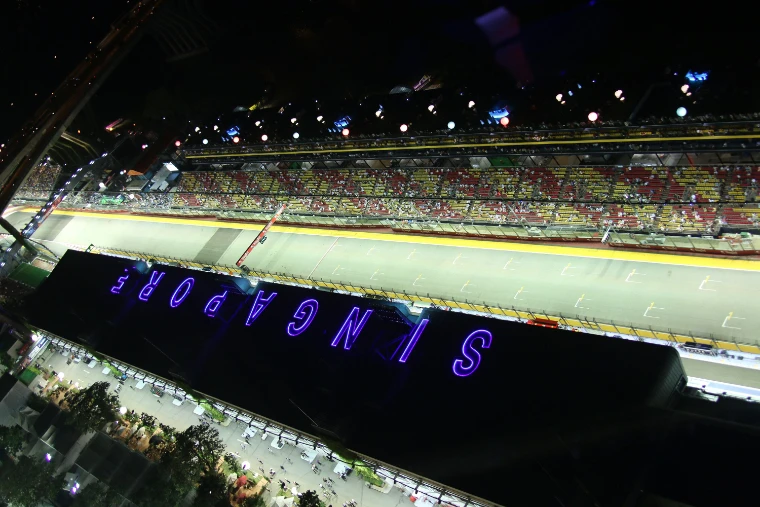
The pits are off Republic Boulevard, beside the Singapore Flyer. From there the lap runs under the Benjamin Sheares Bridge, along Raffles Boulevard, Nicoll Highway and Stamford Road, round the Padang past City Hall on St Andrew’s Road, over Anderson Bridge past the Fullerton Hotel, along Esplanade Drive by Merlion Park and back by Raffles Avenue. In 2023 four corners were taken out for NS Square, leaving nineteen, and the race grew from sixty-one laps to sixty-two. Hamilton holds the lap record, 1 minute 33.808 seconds, set in 2025.
About sixteen hundred floodlights are set up along the track, on more than 220 kilometres of cable. They were made for the circuit, four times brighter than the lights of an ordinary stadium, and designed to keep glare and reflection down. An Italian firm, DZ Engineering, has lit the race since 2008. Its general manager, Roberto Grilli, has said that Singapore’s is “the only temporary installation” among the night races, “so it’s like starting from scratch every year”. The rig goes up from the middle of June, and the first test is lit by the end of August; for the rest of the year the kit is stored in a building of 38,000 square metres at Tampines.
It is a hard race to drive. Hamilton said in 2008 that it took twice the energy of Monaco a lap, and a driver can lose as much as three kilograms over the evening. The race runs close to the two-hour limit, and four have been stopped by the clock before the laps were done. Until 2024 every Singapore Grand Prix had brought out the safety car at least once.
The Weekend
The weekend runs from the Friday to the Sunday, late in the day and into the night. In 2026 it is a Sprint weekend, the first in Singapore: practice at half past four on the Friday afternoon and Sprint qualifying at half past eight that night; the Sprint, of twenty-one laps, at five on the Saturday, and qualifying at nine; and the Grand Prix at eight on the Sunday, sixty-two laps or two hours. The Porsche Carrera Cup Asia runs in support.
The Circuit Park around the track covers the ground of some eighty football pitches, with nine entrances, and there are concerts on the Padang Stage through the weekend. On the Thursday, 4,500 people drawn by ballot walk the pit lane.
The Paddock Club is above the pits: air-conditioned suites, a walk down the pit lane each day, an atrium with restaurants from several Michelin-starred kitchens, free-flowing champagne, a ride on the Singapore Flyer, and a rooftop terrace for the fireworks after the race.
In 2025 George Russell won from pole for Mercedes, with Verstappen and Norris behind him, in the fastest Singapore Grand Prix yet and the first in which every car finished; for the second year there was no safety car. The 2026 race, the seventeenth round of the championship, is run from 9 to 11 October, with the first Sprint in the race’s history, and almost all the hospitality is sold out.
What to Know
It runs from a Friday to a Sunday in early October: in 2027, from 8 to 10 October. The race starts at eight on the Sunday night.
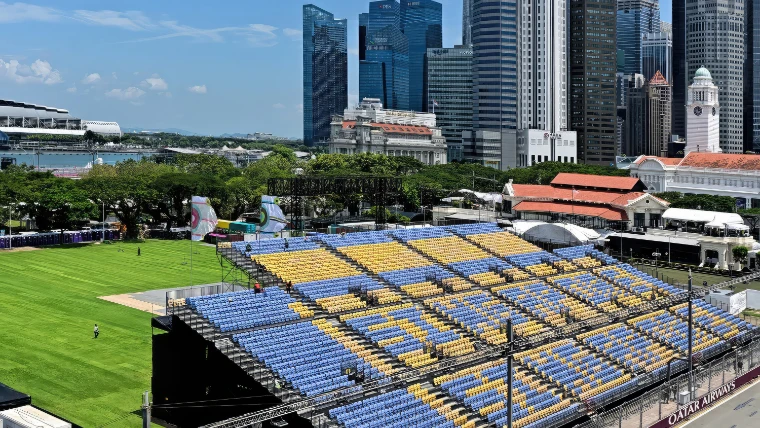
Hospitality is sold only for all three days: the Vista Suite from S$7,508, and the Paddock Club, which is sold out for 2026. Three-day seats in the grandstands cost from S$1,208, at Raffles, to S$1,798, at Marina Bay and Turn 2, and Formula One itself recommends the Turn 1 grandstand for the start. A walkabout ticket costs from S$298 for the Friday to S$728 for all three days.
Smart casual. Nothing is published, and the Court’s version is a jacket without a tie, proper trousers and proper shoes, and no logos. October in Singapore is about thirty-two degrees by day and humid, and storms are common in the late afternoon and early evening.
Changi Airport is a short ride from the city. The hotels at the circuit are close enough to walk from: the Mandarin Oriental, the Conrad, the Pan Pacific and the Ritz-Carlton Millenia on the Promenade side, the PARKROYAL Collection, and the Fullerton, which the track passes. Raffles Hotel, the home of the Singapore Sling, is a few streets away. Paddock Club guests are driven to the door. Otherwise the trains run later on race nights, to Nicoll Highway, Promenade, City Hall and Esplanade. The laws are strict: no vapes, which are illegal even to carry; no eating or drinking on the trains or in the stations; and no drinking in public between half past ten at night and seven in the morning, outside licensed bars.
The mistake is a ticket from anyone but the organisers or their official resellers. Tickets bought on Carousell or Viagogo are voided without refund.
The Court
The Singapore Grand Prix is not the Court’s own. Places in the Paddock Club, above the pits, are sought on a member’s behalf, and the Court arranges the whole of it: getting there, where to stay at Marina Bay, and the table afterward. Formula One comes to Austin later in the month for the United States Grand Prix.
How one becomes a member is set out under Admission.
Set down October MMXXVI