LE MANS 24 HOURS
Mid June · Circuit de la Sarthe, Le Mans · A Day and a Night · Since 1923
2027: 9 to 13 June
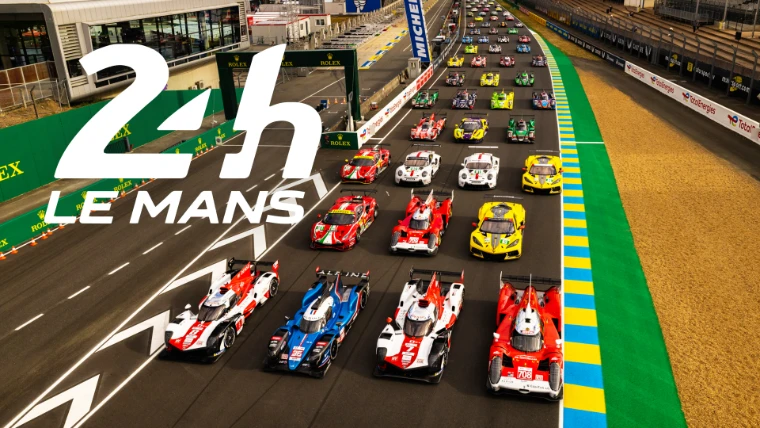
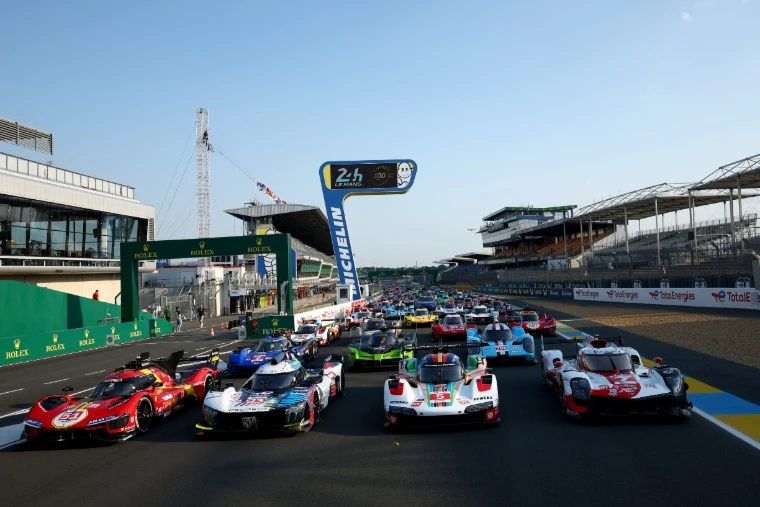
The Le Mans 24 Hours is a motor race of a day and a night in mid-June, on racetrack and closed public roads south of Le Mans: some sixty cars in three classes, three drivers to each, and the win to whichever car has gone farthest when the twenty-four hours are up.
Until 1969 the drivers began it by running across the track to their cars. That year Jacky Ickx walked, and won.
The Walk
Le Mans had held the first Grand Prix, in 1906, on a triangle of public roads outside the town. In 1923 its automobile club, the Automobile Club de l’Ouest, which still runs the race, set a different test: cars as they were sold, driven for a day and a night.
The first was run on 26 and 27 May 1923. The cars carried sixty kilograms of lead for every seat but the driver’s, and none had a windscreen wiper. It began at four in the afternoon, just after a hailstorm, and the clocks went forward in the night, so that it ended at five.
Thirty cars finished, a number not matched at Le Mans until 1993. Behind the stands there were cafés, and a dance floor with a jazz band.
The cars were lined up along the pits, and at the fall of the flag the drivers ran to them from the far side of the track. Some set off before fastening their belts.
In 1969 Ickx walked across, fastened his, and only then moved off. He won by a hundred and twenty metres. On the first lap John Woolfe, who had run, was killed.
From 1970 the drivers began strapped in, and since 1971 the race has had a rolling start.
The Distance
The circuit is just over thirteen and a half kilometres long, much of it public road, closed for the race and open for the rest of the year. Its straight, the Hunaudières, which the English call the Mulsanne, runs for six kilometres. In 1988 a car was timed on it at four hundred and seven kilometres an hour, and since 1990 it has been broken by two chicanes.
Three drivers share each car, and none may drive more than four hours in six, or fourteen in all. The race is run close to midsummer, and has the shortest night of the year.
In 1955 a Mercedes went into the crowd, killing its driver, Pierre Levegh, and more than eighty spectators. It is the worst disaster in the history of motor racing. The pits were pulled down and rebuilt further back.
Tom Kristensen, a Dane, has won it nine times, and Porsche nineteen. The farthest any car has gone is five thousand four hundred and ten kilometres, by an Audi, in 2010.
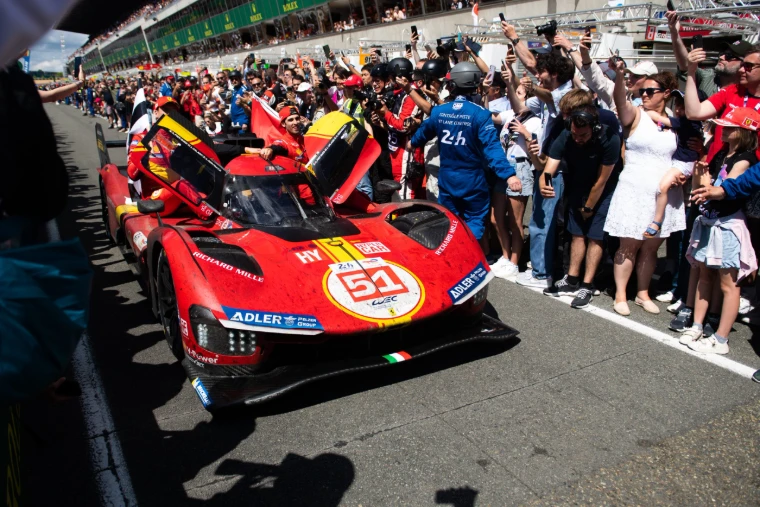
In 2026 Toyota won it, with Mike Conway, Kamui Kobayashi and Nyck de Vries, ending three years of wins for Ferrari.
What to Know
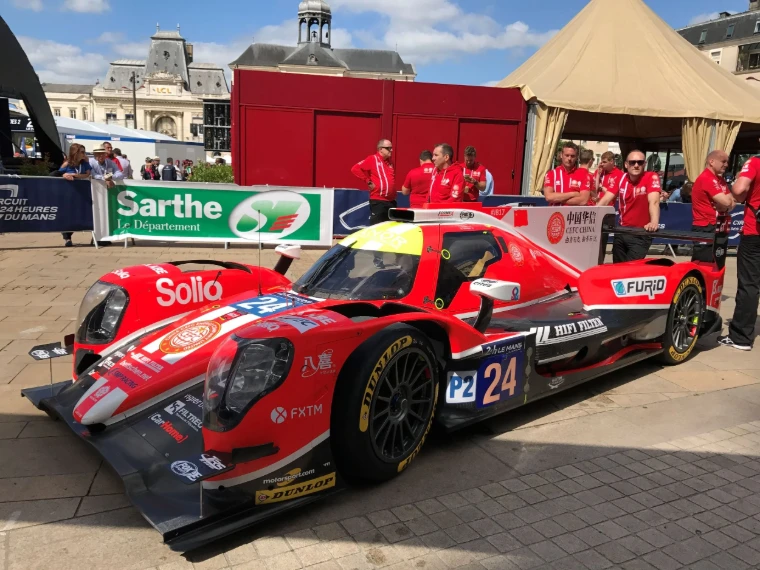
Race week begins the weekend before, when the cars are inspected in public in the centre of Le Mans, and goes on through a test day on the Sunday and practice and qualifying from the Wednesday. The race starts at four on Saturday afternoon and ends at four on Sunday.
Smart casual. The race runs through the night, and it often rains.
Hospitality is above the pits, looking over the pit straight. The Dunlop Curve is the place for the start, Arnage for the sunset, and the pit lane for the finish, at the foot of the podium. On the Friday afternoon the whole circuit is open to the public.
Le Mans is under an hour from Paris on the fastest trains. Stay in the Sarthe, or in Paris.
The mistake is to sleep through Sunday morning, which Le Mans calls happy hour. Watch it from the banks at the Forest Esses.
The Court
The Le Mans 24 Hours is not the Court’s own. Hospitality above the pits is sought on a member’s behalf, and the Court arranges the whole of it: getting there, where to stay in the Sarthe, and the table afterward.
How one becomes a member is set out under Admission.
Set down September MMXXVI · Revised October MMXXVI