
ROLAND GARROS FINALS
Early June · Stade Roland Garros, Paris · Two Days · Since 1891
2027: 17 May to 6 June
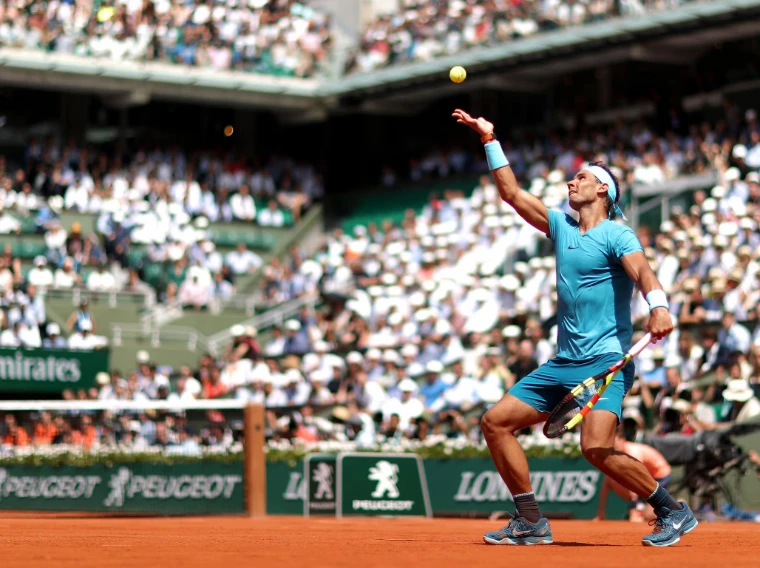
The Roland Garros finals are the last weekend of the French championship of tennis, the only one of the four majors played on clay: the women’s final on the Saturday and the men’s on the Sunday, early in June, at Porte d’Auteuil on the western edge of Paris. The championship has been played since 1891, and at Roland Garros since 1928.
The stadium is named for an airman, not a tennis player. He had been dead nearly ten years when it opened.
The Airman
Roland Garros was born on Réunion in 1888 and studied at HEC, the business school in Paris. He learned to fly in 1909, and on 23 September 1913 made the first non-stop flight across the Mediterranean, from Fréjus to Bizerte, in Tunisia, in nearly eight hours.
In the war he fitted steel wedges to his propeller so that a machine gun could fire through it, and in April 1915 shot down three German aircraft with it.
On 18 April his engine failed and he came down behind the German lines. The Germans took his aeroplane to Anthony Fokker, who answered it with a gear that let German pilots fire through the propeller, and Garros spent nearly three years a prisoner.
He escaped in February 1918, went back to the front, and was shot down and killed near Vouziers on 5 October 1918, a day short of his thirtieth birthday.
When a new stadium was wanted in 1928, Émile Lesieur, who had been at HEC with him and was president of the Stade Français, gave the land on one condition: that it carry his classmate’s name.
The Musketeers
The championship began in 1891 for members of French clubs, and its first winner was a Briton living in Paris. It opened to players from abroad in 1925.
Two years later France’s four best players, René Lacoste, Jean Borotra, Henri Cochet and Jacques Brugnon, won the Davis Cup from the United States in Philadelphia. France needed a ground on which to defend it, and Roland Garros was built for the purpose. The championship moved there in May 1928, France held the Cup there that July, and kept it until 1933.
The four stands of the centre court are named for them, and the men’s champion is given the Coupe des Mousquetaires.
Lacoste was called the Crocodile, after a bet, the story goes, over an alligator-skin suitcase, and in 1933 he founded a company to make a shirt with the animal on it. The ball boys and girls wear his shirts.
The women’s champion is given a cup named for Suzanne Lenglen, who won the championship six times in the 1920s. The third court is named for Simonne Mathieu, champion in 1938 and 1939, and a leader of the Resistance in the war.
In 1968 it was the first of the majors to open to professionals.
The Clay
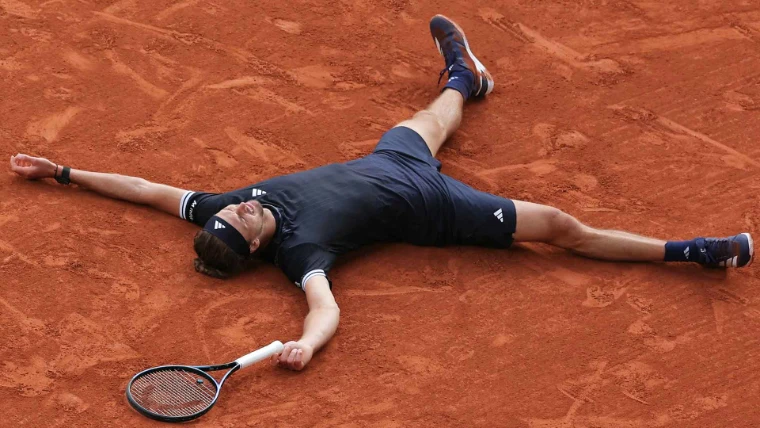
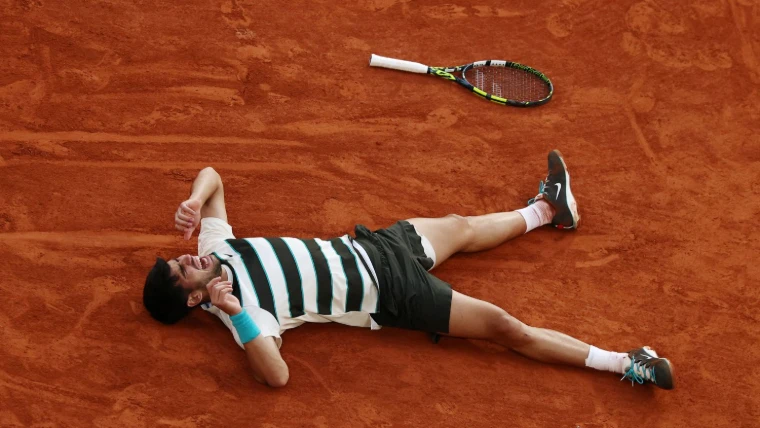
The clay is not clay. Each court is white limestone under a few millimetres of crushed red brick, laid over volcanic rock, sand and concrete, and the brick is topped up every day of the tournament.
It slows the ball and sends it up high. Pete Sampras won fourteen majors and never this one.
A ball leaves a mark in it. Roland Garros is the only major still to keep its line judges, and when a call is disputed the umpire climbs down from the chair to look at the mark.
Rafael Nadal won it fourteen times, and in 2025 a plaque with the print of his right foot was set into the clay of the centre court. Chris Evert won it seven times, more than any other woman.
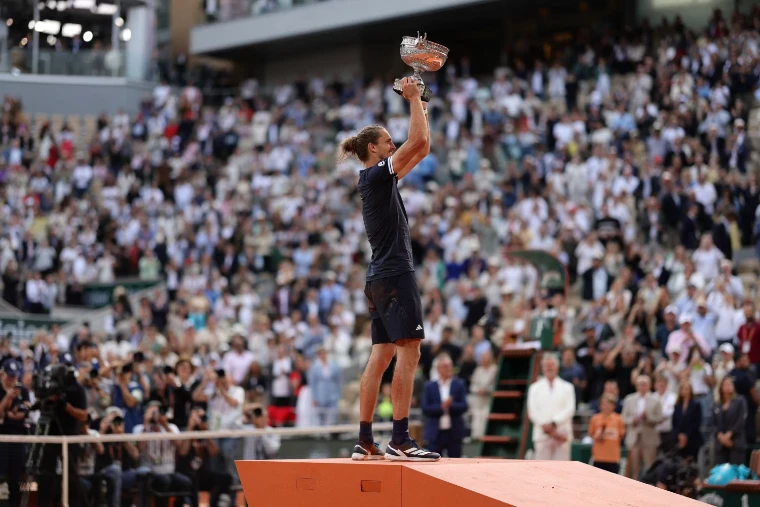
In 2026 Mirra Andreeva won the women’s title, and Alexander Zverev the men’s in five sets, the first German man to win a major since Boris Becker in 1996.
What to Know
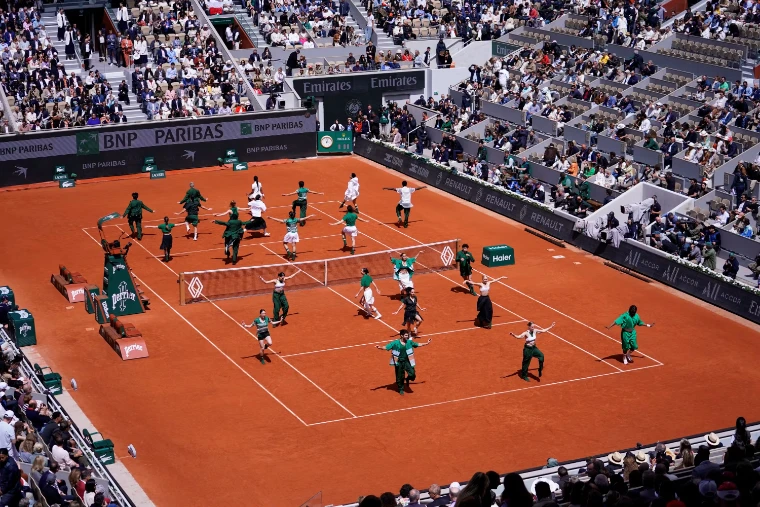
The women’s final is on the Saturday and the men’s on the Sunday, on Court Philippe-Chatrier, which has had a roof since 2020.
A lounge suit, in something light.
The seats to have are low on Chatrier. The Village, beside the courts, is where the tournament entertains.
The Métro stops at Porte d’Auteuil and at Michel-Ange-Molitor, a short walk from the gates. Stay in the sixteenth, or nearer the centre.
The mistake is to see only the finals. The Tenniseum, in an old groundsman’s cottage, holds the championship’s trophies and films going back to 1897, and a ticket-holder gets in free.
The Court
The Roland Garros finals are not the Court’s own. Seats on Court Philippe-Chatrier for both finals, and a table in the Village, are sought on a member’s behalf, and the Court arranges the whole of it: getting there, where to stay in Paris, and the table afterward. Wimbledon follows three weeks later, for a member who wants both.
How one becomes a member is set out under Admission.
Set down September MMXXVI · Revised October MMXXVI