
TANGLEWOOD
July into August · Lenox, Massachusetts · Seven Weeks · Since 1937
2027: dates to follow
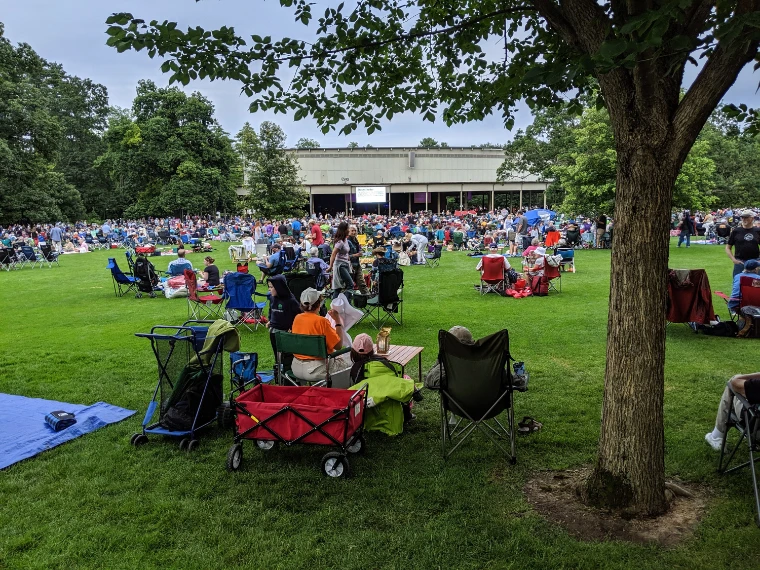
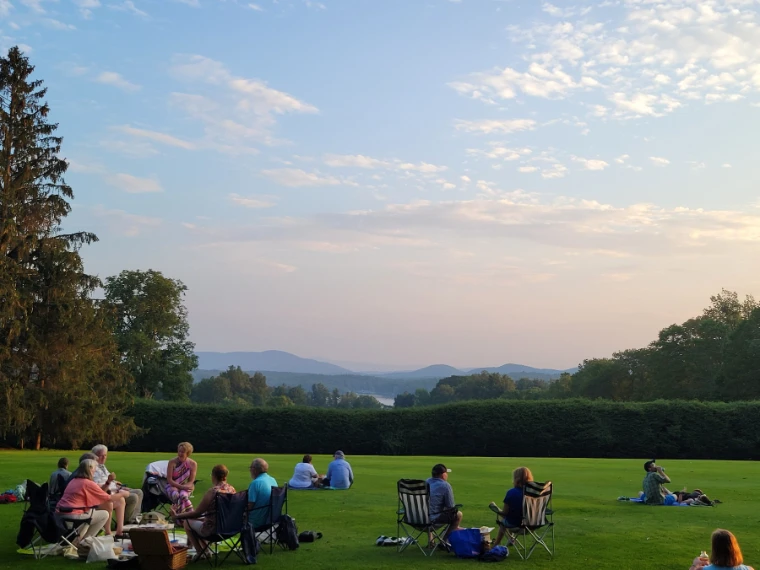
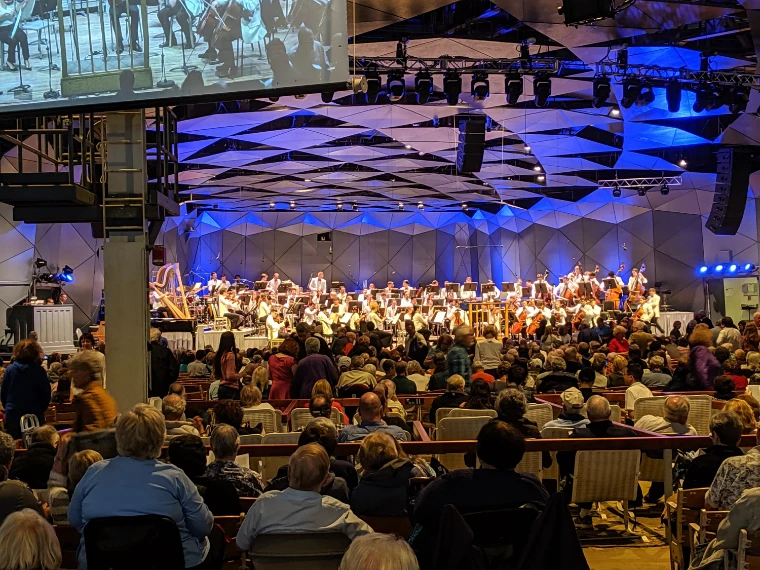
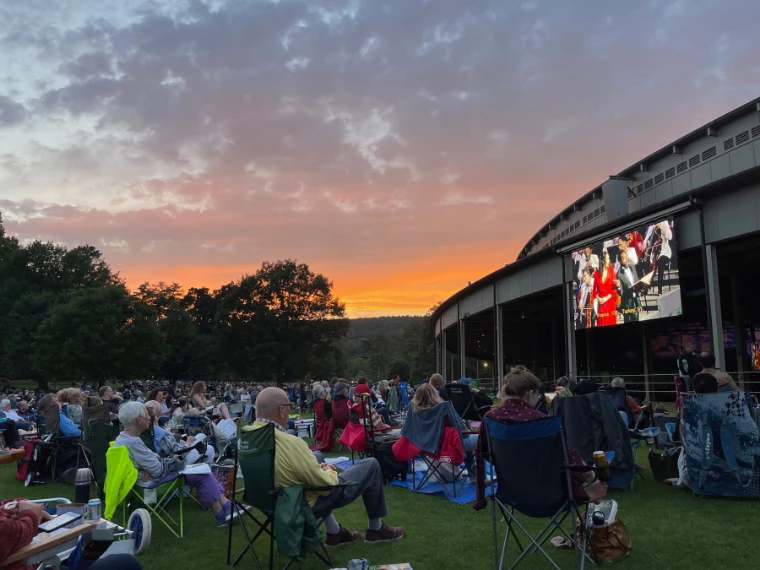
Tanglewood is the summer home of the Boston Symphony Orchestra, an estate of lawns and old trees in the Berkshire Hills between Lenox and Stockbridge, in western Massachusetts. From early July to late August the orchestra plays there on Friday, Saturday and Monday evenings and Sunday afternoons, in an open-sided Music Shed looking onto a lawn where thousands more listen on blankets and at laid tables, with the evening going down over the Stockbridge Bowl. The festival around it runs from late June to Labor Day.
The Shed is called a shed because its architect said it would be one. When the trustees twice asked Eliel Saarinen to cut his plans to their budget, he warned them they would end up with “just a shed”.
The Tappan Gift
In 1934 the conductor Henry Hadley, looking for a place for summer concerts, found Gertrude Robinson Smith, a New Yorker who summered in the Berkshires and who launched a festival, in the middle of the Depression, in three months. Hadley conducted members of the New York Philharmonic that August in a horse-show ring at Interlaken, before the President’s mother. In 1936 the organisers asked the Boston Symphony and its music director, Serge Koussevitzky, instead, and nearly fifteen thousand came to hear them under a tent.
That winter Mrs Gorham Brooks and her aunt Mary Aspinwall Tappan offered the orchestra their family’s estate, Tanglewood. “One day I attended a concert of the Boston Symphony in Symphony Hall,” Mrs Brooks said, “and the thought came to me how beautiful it would be if Tanglewood could be the home of music. By intermission I made up my mind to make the offer.” The name came from Nathaniel Hawthorne, who had lived in a little red farmhouse on the land and wrote for children there.
The first season at Tanglewood, in 1937, was played in a tent. At an all-Wagner concert that August a thunderstorm twice stopped the Rienzi overture, and the Forest Murmurs from Siegfried had to be left out. At the interval Miss Robinson Smith appealed for a permanent building, and thirty thousand dollars was pledged in minutes. The Stockbridge engineer Joseph Franz built the Shed from Saarinen’s simplified plans, ahead of time and under budget, and it opened on 4 August 1938.
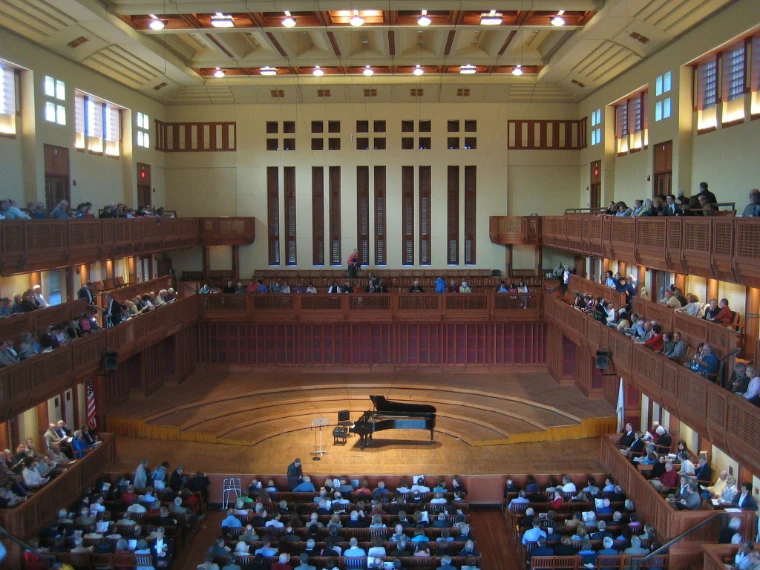
In 1940 Koussevitzky opened a summer school for young musicians, now the Tanglewood Music Center; Leonard Bernstein was in its first conducting class, and its later students include Seiji Ozawa, Claudio Abbado and Zubin Mehta. Bernstein gave his last concert at Tanglewood in 1990. Seiji Ozawa Hall, for chamber music and recitals, opened in 1994.
The Season
The orchestra’s weeks run from the opening night in early July to Beethoven’s Ninth at the end of August. On Saturday mornings the rehearsal is open to the public. The Boston Pops play too, James Taylor plays the Fourth of July and has played Tanglewood most summers since 1974, and the young players of the Music Center give concerts of their own in Ozawa Hall.
The Shed has seats; the lawn is open to anyone with a lawn ticket, who hears the concert through speakers on the back of the Shed. The picnics run from a pizza on a quilt to a full table with linen and a candelabra.
In 2026, the orchestra’s eighty-ninth summer there, Andris Nelsons gave Tanglewood’s first complete Marriage of Figaro on 1 August, which the Boston Globe called “as good as opera in the Shed ever gets”; the orchestra’s board had already decided that his tenure would end after the 2027 season.
What to Know
The orchestra’s season runs from early July to late August, inside a festival from late June to Labor Day. The 2027 dates have not been announced; tickets usually go on sale in March, only from tanglewood.org.
Lawn tickets are cheap, and children under eighteen go free on the lawn for the orchestra’s concerts; seats in the Shed are sold apart.
Tanglewood has no dress code beyond shirts on the grounds and shoes in the halls. Summer clothes, and a sweater for after dark.
Lenox is some two and a half hours from Boston and three from New York. On summer weekends Amtrak’s Berkshire Flyer runs direct from New York to Pittsfield, ten miles away; Albany’s airport is under an hour. The Red Lion Inn in Stockbridge, a tavern since 1773, has lodged the orchestra’s audiences for forty years; Blantyre, a Lenox cottage of 1902, is a hotel.
The mistake is to count on the Shed in the rain. A lawn ticket does not admit one to it, concerts go on rain or shine without refunds, and tents are not allowed on the lawn.
The Court
Tanglewood is not the Court’s own. Seats in the Shed, a place for the picnic on the lawn, and tickets for Ozawa Hall are sought on a member’s behalf, and the Court arranges the whole of it: getting there, where to stay in Lenox or Stockbridge, and the hamper and the table.
How one becomes a member is set out under Admission.
Set down October MMXXVI