THE SALZBURG FESTIVAL
Mid July to Late August · Salzburg · Six Weeks · Since 1920
2027: 16 July to 29 August
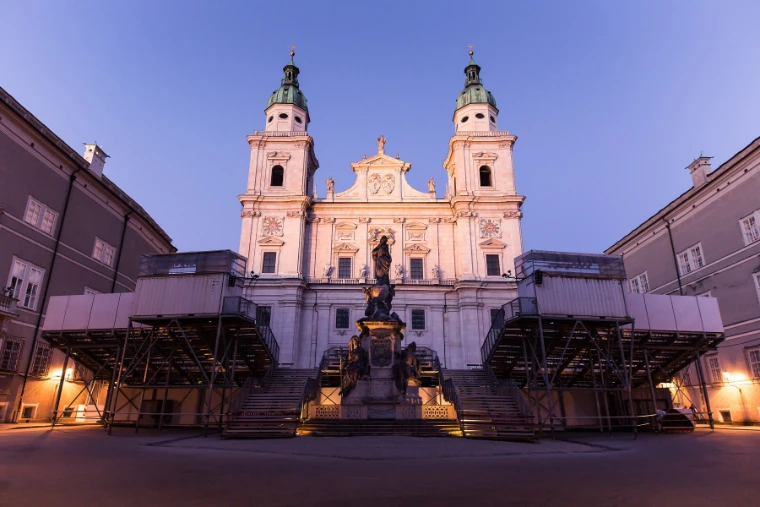
The Salzburg Festival is six weeks of opera, drama and concerts each summer in Mozart’s birthplace, from the middle of July to the end of August: some two hundred performances in three festival houses on the site of the archbishops’ stables, in churches and in the open air. The Vienna Philharmonic plays most of the concerts. Every summer since its first, with a few gaps, Hofmannsthal’s Jedermann has been played on the square before the cathedral.
The cries of “Jedermann!” that summon the rich man to his death come from four men placed around the square: one in the tower of the Franciscan church, two in the cathedral arches, and one on a hill towards the fortress.
The Founders
Salzburg had held Mozart festivals now and then since 1877, and the idea of a festival of its own was in the air before the First World War. In 1918 the director Max Reinhardt, who had bought the palace of Leopoldskron, drew up the plan with the poet Hugo von Hofmannsthal, and with Richard Strauss, the conductor Franz Schalk and the designer Alfred Roller they are counted its founders. What Bayreuth did around one north German, Wagner, Hofmannsthal wrote, Salzburg should do around the art of Austria.
The first festival opened on 22 August 1920 with Jedermann, directed by Reinhardt on the Domplatz, with Alexander Moissi as the rich man. It was a stopgap: the work commissioned for the opening was not finished, and there was not enough timber in post-war Austria to build stands in the riding school. The first opera, Don Giovanni, came in 1922, conducted by Strauss, and the Vienna Philharmonic has played most of the concerts since.
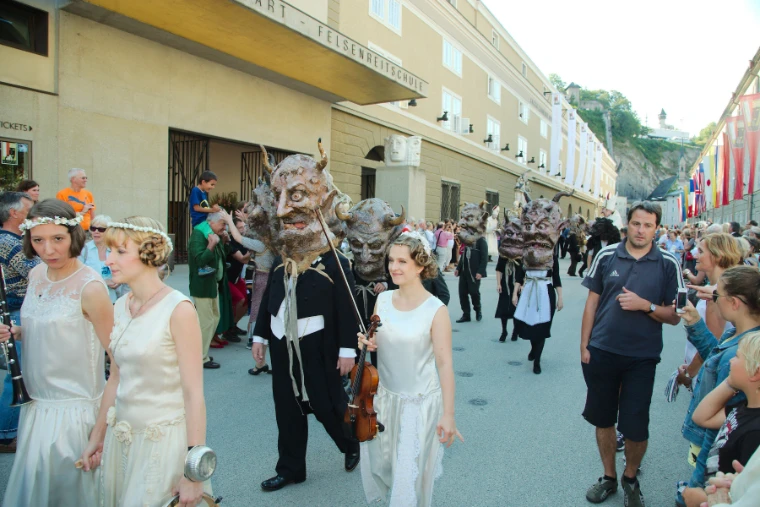
The festival houses grew out of the archbishops’ stables. The Felsenreitschule, a summer riding school cut from the quarry in 1693, its spectators seated in ninety-six arcades in the rock, became a theatre in 1926 with the arcades for a backdrop. Herbert von Karajan, born in Salzburg, made his festival debut there in 1933, ran the festival from 1956 and opened the Grosses Festspielhaus in 1960 with Der Rosenkavalier.
In 1938 Toscanini withdrew; after the Anschluss Reinhardt went into exile and Jedermann was banned; the festival went on under the Nazis until 1944, when Goebbels cancelled it. It was revived in 1945, and Jedermann was back on the square by 1947.
The Six Weeks
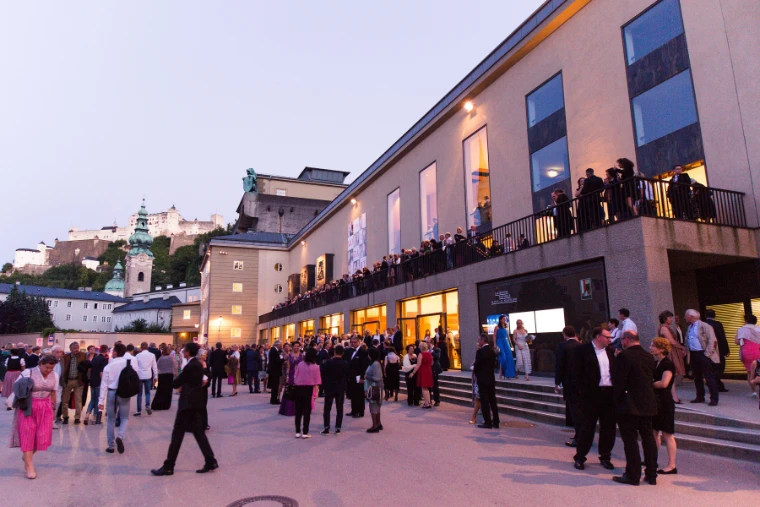
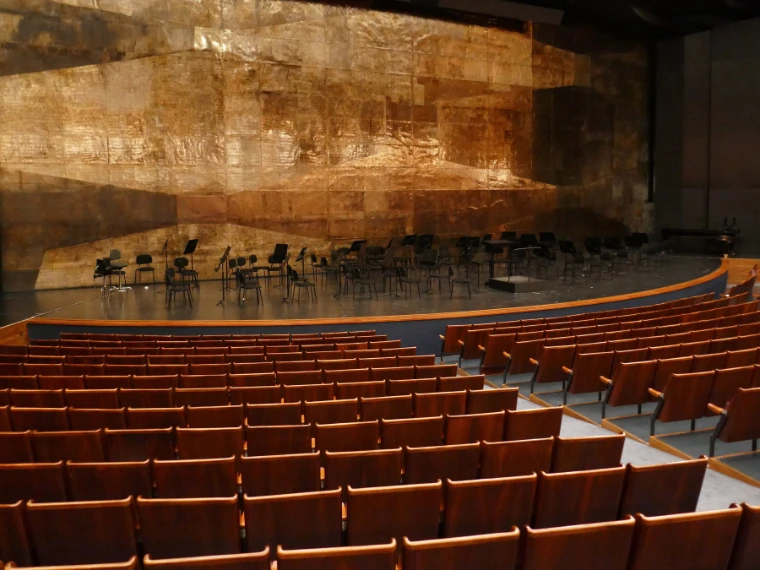
The opera is given in the three houses side by side: the Haus für Mozart, the Felsenreitschule, whose roof can be opened to the sky, and the Grosses Festspielhaus, with its stage a hundred metres wide. Jedermann is played on the Domplatz in the late afternoon, as Reinhardt timed it, when the square is still in sunlight and the shadows lengthen towards the end; in rain it moves indoors. Mozart’s Mass in C minor has been sung at St Peter’s since 1927.
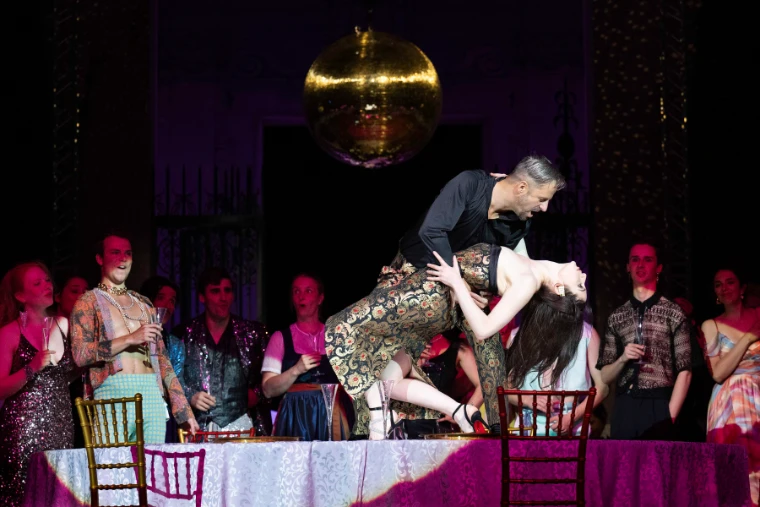
The audience dresses for it. Evening clothes for the opera, dinner jackets and long dresses, and for Jedermann the Salzburg costume, dirndl and lederhosen, which has been worn to the festival since the 1920s.
In 2026, from 17 July to 30 August, there were 172 performances and 261,300 visitors, with 99 per cent of seats sold; Asmik Grigorian sang her first Carmen under Teodor Currentzis, and Jedermann was played on the Domplatz only eight times out of fifteen.
What to Know
It runs from the middle of July to the end of August: in 2027, from 16 July to 29 August. The programme is expected in early December.
Tickets are ordered in writing, from the programme’s publication to a deadline in January, and allotted by the end of March; what is left is sold from then on. It does not matter how early one orders, only that one orders before the deadline, and friends of the festival are served first, and long attendance counts.
The festival asks for festive, elegant evening dress, and has no rules beyond that. Black tie for the opera; Tracht, of the real kind, for Jedermann.
Munich is an hour and a half away by train and Vienna about two and a half; Salzburg’s own airport is a few minutes from the town. The Goldener Hirsch, by the festival houses, has been the festival’s hotel since the 1940s; the Sacher is another, and Reinhardt’s Leopoldskron is a hotel now.
The mistake is to miss the deadline. Orders made after it go to the back of the queue, behind every one made in time.
The Court
The Salzburg Festival is not the Court’s own. Seats for the opera, the concerts and Jedermann are ordered on a member’s behalf before the deadline, and the Court arranges the whole of it: getting there, where to stay in the old town or at Leopoldskron, and the table afterward. Bayreuth opens a week later.
How one becomes a member is set out under Admission.
Set down October MMXXVI