THE DUBLIN HORSE SHOW
Early August · The RDS, Ballsbridge, Dublin · Five Days · Since 1864
2027: 4 to 8 August
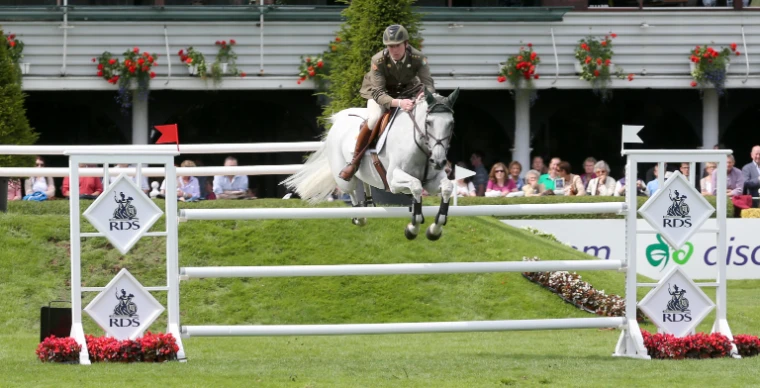
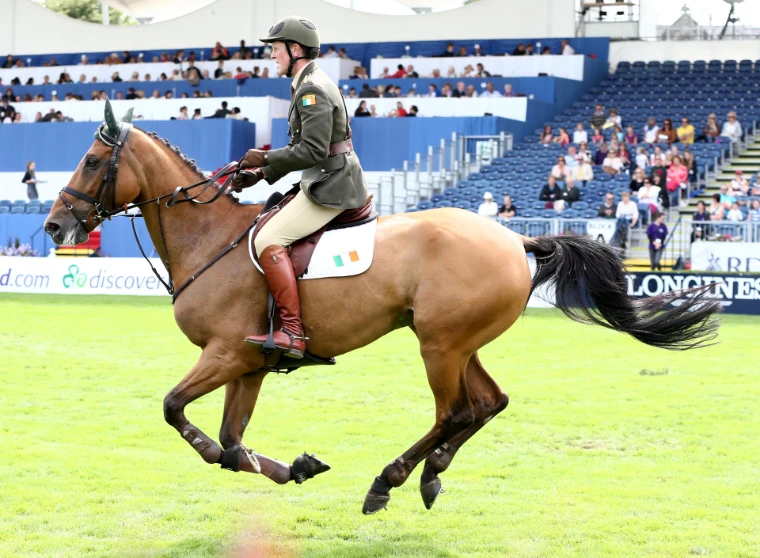
The Dublin Horse Show is five days of horses in early August at the RDS, on Merrion Road in Ballsbridge, from a Wednesday to a Sunday: more than a hundred and thirty classes of showing and jumping across the main arena, two rings and Simmonscourt, with the Nations’ Cup for the Aga Khan Trophy on the Friday and the Rolex Grand Prix on the Sunday. It is given by the Royal Dublin Society, which was founded in 1731 and is still a members’ club.
In 1868 the first prize over the six-foot Stone Wall went to a hunter called Shane Rhue, and he was sold for £1,000 later that day.
Ball’s Bridge
The Dublin Society was founded on 25 June 1731, chiefly by Thomas Prior, for improving husbandry, manufactures and other useful arts. It bought Leinster House, the Duke of Leinster’s town house, in 1815, and took the prefix Royal in 1820, when George IV became its patron. The first horse show was held in 1864 under its auspices but organised by the Royal Agricultural Society of Ireland, with 366 entries and a prize fund of £520. The Society ran its own from 28 to 30 July 1868, on the lawns of Leinster House: a show of led horses, with leaping. The rule for the leaping was simply that “the obstacles had to be cleared to the satisfaction of the judges”.
In 1879 the Society bought its ground at Ballsbridge, named for the bridge over the Dodder that the Ball family built and owned, and in 1881 the show moved there, to a greenfield site, with the first continuous leaping course and a first stand, for eight hundred, where the Grand Stand is now. Women first jumped in 1919, on the second day, and that day became Ladies’ Day.
In 1925 a colonel of the Swiss Army proposed an international competition, and the Aga Khan of the day gave a challenge trophy, “in appreciation of all the pleasures he had had at previous horse shows and in gratitude of his Irish tutor, Mr. Kenny”. It was put on the Friday, “having no major attraction”. Six teams of army officers jumped for it in 1926, and the Swiss won on Irish-bred horses. Ireland first won at home in 1928, and took the trophy outright in 1937, with Red Hugh, of whom it is written that he “never put a foot wrong”. The teams were military until 1949, and women rode on them from 1954. The present trophy, the sixth, was given by the Aga Khan in 1980.
There was no show during the First World War, nor from 1940 to 1946, nor in 2020. The World Championships were jumped within the show in 1982.
The Week
The Wednesday opens it. The Thursday is the Best Dressed competition on the Band Lawn, “formerly known as Ladies Day”, with ten thousand euros to the winner. The Friday is the Nations’ Cup. On the Saturday evening, from six, comes the Puissance, over the big red wall. The Sunday is the Rolex Grand Prix, one of seven in the Rolex Series.
Between them run the showing and jumping classes, across the main arena, Ring 1, Ring 2 and Simmonscourt, with more than three hundred and fifty stands to walk among. The doors open at nine; an early entrance through the Concert Hall opens at seven, and an evening programme in the Concert Hall from six is included in the day’s ticket.
In 2026, from 5 to 9 August, the show kept the centenary of Nations’ Cup jumping at Dublin, the hundredth running for the Aga Khan Trophy. The new Laya Arena, with 6,775 seats and the new Anglesea Stand, was opened on the first day. Eight teams came, among them the six of 1926. Daniel and Jordan Coyle became the first brothers to ride on one Irish team, and both jumped double clear; but Laura Kraut’s clear last round on Baloutinue decided it, Cian O’Connor had four faults on his twentieth Aga Khan cap, and the United States won for the ninth time, with Ireland second. Steve Guerdat won the Grand Prix on the Sunday, which carried a record prize fund of a million euros.
What to Know
It runs for five days, Wednesday to Sunday, in early August. In 2027 it is from 4 to 8 August.
Tickets are sold only through Ticketmaster. A day’s admission, thirty euros in 2026, covers the grounds but not the main arena, which needs a seated ticket; Friday’s are priced apart. Hospitality, with lunch, wine and a reserved seat in the Anglesea Stand, cost from €340 a head in 2026, and €410 on the Friday.
A lounge suit, in a light cloth. Nothing is published for those watching; a hotel beside the showground speaks of summer suits and lightweight tailoring, and of an extra effort on the Thursday.
There is no parking at the RDS during the show. The DART stops at Lansdowne Road and Sandymount, a short walk away; when there is a match at the Aviva Stadium, use Sandymount. Be set down on Merrion Road or at the InterContinental’s entrance. The InterContinental is a two-minute walk from the showground, and the Herbert Park Hotel three. In town, the Shelbourne on St Stephen’s Green has stood since 1824, and the Constitution of the Irish Free State was drafted in one of its rooms in 1922.
The mistake is to buy a day’s admission and expect the Nations’ Cup. It gives access to all areas “except for the Main Arena, which requires an Arena access ticket”, and once inside there is no going out and coming back.
The Court
The Dublin Horse Show is not the Court’s own. Seats in the Anglesea Stand for the Nations’ Cup on the Friday, with lunch, are sought on a member’s behalf, and the Court arranges the whole of it: getting there, where to stay in Ballsbridge or on St Stephen’s Green, and the table afterward. The Glorious Twelfth follows within the week.
How one becomes a member is set out under Admission.
Set down October MMXXVI