
POLO IN THE HAMPTONS
Late July · Bridgehampton · An Afternoon · Hosted by the Court
2027: dates to follow
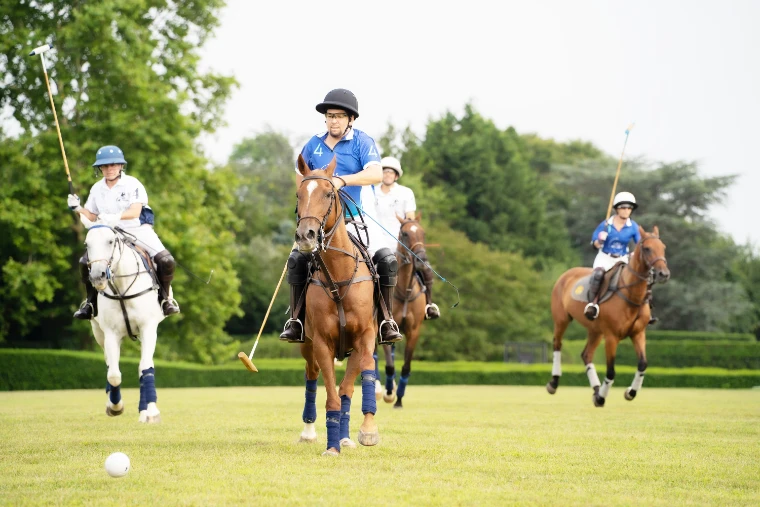
Polo in the Hamptons is a Saturday afternoon in late July at Bridgehampton, for twelve members: a cabana at the side of the field at Polo Hamptons, on Lumber Lane, for one match of four chukkas, with the divot stomp at half-time and dinner afterward.
It exists so that a member who has never watched polo learns to see the line of the ball, on which most of the game’s fouls turn.
The Potato Fields
After Southampton was founded in 1640, settlers moved east to the land the Shinnecock called Sagaponack and Mecox, and at the head of Sagg Pond they founded a hamlet called Bullhead. Ezekiel Sandford built a bridge across the pond in 1686, linking Mecox and Sagaponack, and the hamlet was renamed for it. For about two centuries potato fields “extended in every direction from the four-block Main Street”, worked by Polish families “mostly of farming extraction”, and there were “five large potato packing barns”. The hamlet became home, too, to the Hampton Classic horse show and to a road-racing course “that figured prominently in American automobile racing”.
The game is older than any of it. Polo descends from chovgan, played in Persia from the sixth century BC, and is often called the Sport of Kings; the word comes from Manipur, where polo or pulu was the wooden ball, and Europeans formed a club at Silchar, in Assam, in 1859. In 1876 James Gordon Bennett Jr. organised what was billed as the first polo match in the United States, indoors, at Dickel’s Riding Academy on Fifth Avenue at 39th Street. Under Harry Payne Whitney, early in the twentieth century, the American game became a fast one.
In the 1990s Peter Brant, with Neil Hirsch, founded the Bridgehampton Polo Club at Two Trees Farm, on Hayground Road. Its colours were navy and white. Brant brought the Mercedes-Benz Polo Challenge there for fifteen consecutive years, and the club played on six Saturdays between July and August; in 2012 Nacho Figueras was Brant’s partner in the club, and Brant’s team, White Birch, beat Figueras’s Circa by two goals to one in an exhibition, and in 2014 the public came in for thirty dollars a car, for the Bridgehampton Childcare and Recreational Center. Then the land was sold, and the polo fields became “ranch homes”.
In 2016 Justin Mitchell started Polo Hamptons, at 900 Lumber Lane, to take its place. It plays on Saturdays in July; in 2026 they were 18 and 25 July.
The Afternoon
Twelve places, in one cabana at the side of the field.
The Court’s cars bring the party from Southampton or the station, and it is in the cabana by four, for the cocktails before the match.
Where it can be arranged, a player walks the party along the pony lines before the first chukka. The ponies are full-sized horses; the word is only tradition. Each player brings more than one and changes between chukkas, and their manes are usually hogged and their tails braided or docked so that nothing catches the mallet.
Two teams of four play on ten acres, “the largest playing field of any modern sport”, at up to thirty-five miles an hour. There are four chukkas, each of seven minutes, played on for thirty seconds more or until a stoppage. The player who hits the ball generally has the right of way along its line, and nobody may cross it in front of him; the ride-off, shoulder to shoulder, is how an opponent is pushed off it.
At half-time the party goes out onto the field with everyone else to tread the divots back into the turf, a custom kept “to afford spectators the opportunity to walk about and socialise”.
The match ends at seven. The cars are waiting, since leaving is slow “after 900 guests simultaneously decide they need dinner”, and the Court’s table is a short drive away.
What Is Asked
The published guidance is casual: linen blazers, polo shirts, chinos or tailored shorts, and loafers without socks; for women, midi dresses or sundresses, wedges or block heels, and wide-brimmed hats. The Court dresses a step above it: a linen jacket, a collared shirt and trousers, not shorts; summer dresses, and heels that will not sink in the turf.
Stay behind the sideline. A pony at the gallop does not stop for a spectator.
Telephones stay in pockets while a chukka is played.
Nobody is pitched in the cabana.
The Places
Twelve. It is as many as one cabana will hold with a clear view of the field.
Members are written to in April; by one magazine’s account, the afternoon has sold out by 10 July for ten years running.
The sum is stated in the invitation and covers the cabana, the cars and dinner.
From Manhattan, the Cannonball leaves Penn Station on summer Friday afternoons, non-stop to Westhampton, and the Hampton Jitney picks up along Lexington Avenue; Bridgehampton has its own station on the Montauk Branch; the first opened there in 1870. The Court’s Beach House is in Southampton through the same weeks.
How one becomes a member is set out under Admission.
Set down October MMXXVI