
THE OPERA, BALLET AND PHILHARMONIC EVENINGS
Late November · Lincoln Center, New York · An Evening · Music
Hosted by the Court
- DatesThe 2027 dates are to follow
- WhereLincoln Center, New York
- DressLounge suit
- AdmissionHosted by the Court
- In companyRSVP tells the Secretary that a member means to attend. Send passes the engagement’s name, its date and the address of its page to whomever the reader chooses, or, on a computer, copies the address; the Court itself sends and keeps nothing.RSVP
The Opera, Ballet and Philharmonic Evenings are evenings for members at Lincoln Center in late November.
It exists because the three companies play on one plaza, and a party can hear all three in a single month.
Lincoln Center
Lincoln Center is a complex of 16.3 acres on the Upper West Side, home to the New York Philharmonic, the Metropolitan Opera, New York City Ballet, the Chamber Music Society and Juilliard. It was built under John D. Rockefeller III as part of Robert Moses’s Lincoln Square urban renewal, and “more than 7,000 residents and 800 businesses from the San Juan Hill area” were moved out to make room for it. Ground was broken on 14 May 1959, with President Eisenhower; Philharmonic Hall opened on 23 September 1962, the New York State Theater on 23 April 1964, and the Metropolitan Opera House on 16 September 1966. The square was named Lincoln in 1906, and “records give no reason for choosing that name.”
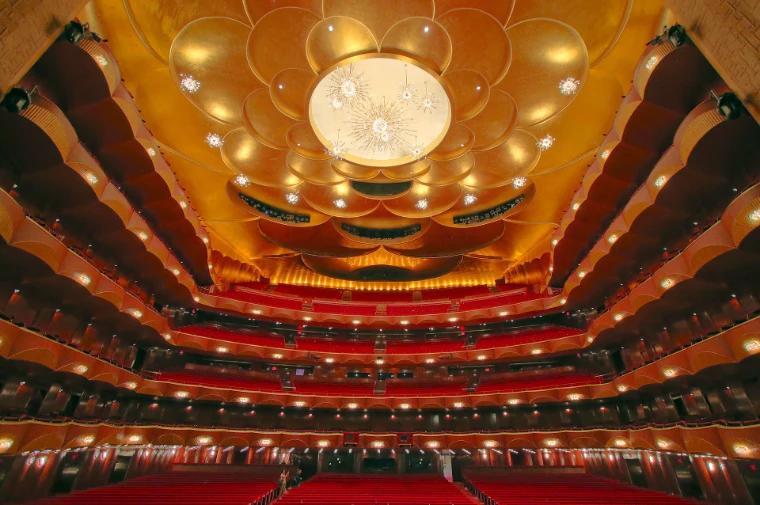
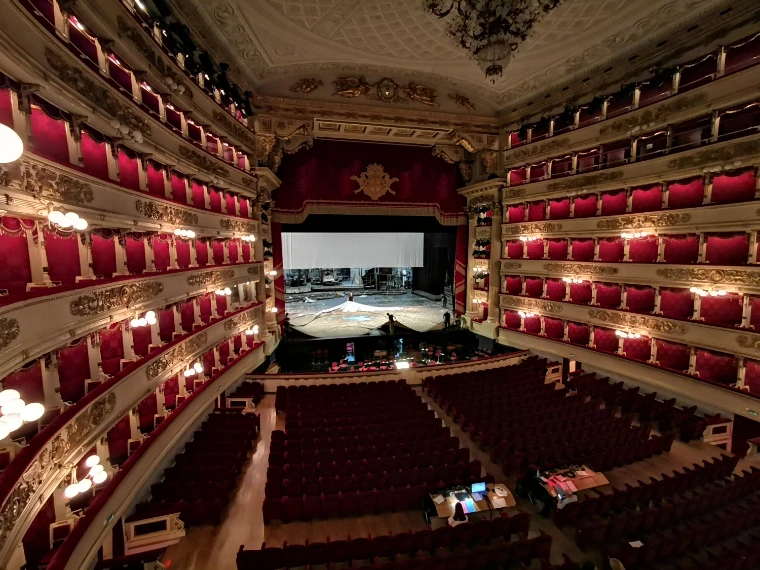
The Met’s house is by Wallace K. Harrison, whose built design was his forty-third. It replaced the house of 1883 at Broadway and 39th Street, holds 3,975 with 175 standing, and is “the largest repertory opera house in the world”. It opened with the first performance of Barber’s Antony and Cleopatra, staged by Franco Zeffirelli. Two Chagall murals, The Sources of Music and The Triumph of Music, each about thirty feet by thirty-six, hang in the lobby; in 2026, when the Met considered selling them to cover a deficit, Sotheby’s appraised them at $55 million. The chandeliers were refurbished at J. & L. Lobmeyr, in Vienna, in 2008.
George Balanchine and Lincoln Kirstein founded New York City Ballet in 1948. “The only justification I have,” Kirstein wrote in 1946, “is to enable Balanchine to do exactly what he wants to do in the way he wants to do it.” Its theatre, now the David H. Koch Theater, is by Philip Johnson and John Burgee: 2,586 seats in four rings, a fifth ring “faced with jewel-like lights”, and a spherical chandelier under a gold latticed ceiling.
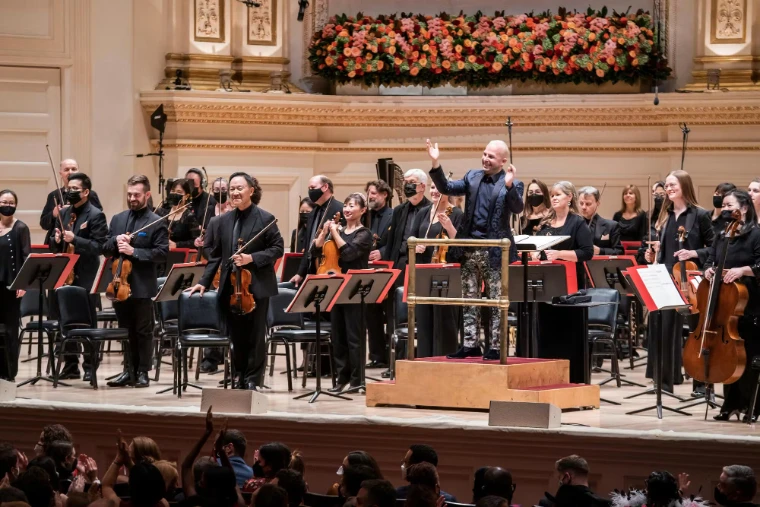
The Philharmonic is the oldest of the “Big Five”. Ureli Corelli Hill founded it in 1842, and it gave its first concert on 7 December that year in the Apollo Rooms on lower Broadway, before six hundred people, opening with Beethoven’s Fifth. Its hall, by Max Abramovitz, was Philharmonic Hall and then Avery Fisher Hall; it reopened as David Geffen Hall on 8 October 2022, with its auditorium renamed the Wu Tsai Theater and 2,200 seats. Gustavo Dudamel begins as music and artistic director in the 2026 to 2027 season.
The November Programme
In November the Met gives Medea, Tosca and a new production of Jenůfa.
New York City Ballet’s autumn season ends on 18 October, and George Balanchine’s The Nutcracker runs from 27 November 2026 to 2 January 2027, so that in late November the ballet is The Nutcracker, with its Christmas tree that grows on the stage. There is no late seating.
At Geffen Hall, Roberto González-Monjas conducts on 19 to 21 November, with Frank Huang in the Mendelssohn Violin Concerto, between Korngold and the suite from Der Rosenkavalier. On 25, 27 and 28 November and 1 December Santtu-Matias Rouvali conducts the first performance of Kevin Puts’s Bassoon Concerto, with Judith LeClair, and Schubert’s “Great” C major. Dudamel’s concert Tosca, on 13 and 15 November, is at Carnegie Hall, not Lincoln Center. The Philharmonic’s tickets for the season are, at present, sold only with a subscription.
The Evenings
Evenings in late November at Lincoln Center: the opera, the ballet and the Philharmonic.
Twenty-five places, held together. The Court takes a block rather than singles, so that members sit as a party.
The programme is circulated at the start of the month.
Supper follows.
What Is Asked
A lounge suit. Nothing is published: the Met has no dress code, and Playbill’s guide says “Dress up as much or as little as you want... Some still wear gowns and gloves.” The Court keeps to the lounge suit.
At The Nutcracker, be seated before the curtain.
Nobody is pitched at supper.
The Places
Twenty-five. A member may bring one guest by arrangement, and answers for them. The sum is stated in the invitation.
The Court’s Friday Supper Club is laid after the theatre hour on the Fridays of the same month.
How one becomes a member is set out under Admission.
Questions
What are the Opera, Ballet and Philharmonic Evenings?
The Opera, Ballet and Philharmonic Evenings are evenings in late November at Lincoln Center, where the three companies play on one plaza. The Court takes a block of places so that members sit as a party, the programme is circulated at the start of the month, and supper follows. The 2027 dates are to follow.
What does one wear to the Opera, Ballet and Philharmonic Evenings?
A lounge suit. The Met has no dress code and nothing else is published, so the Court keeps to the lounge suit.
Who may attend the Opera, Ballet and Philharmonic Evenings?
It is for members of the Court, by the Court’s invitation. There are twenty-five places, held together. A member may bring one guest by arrangement, and answers for them. Nobody is pitched at supper. How one becomes a member is set out under Admission.
- Photograph, Professorcornbread · CC BY-SA 4.0
Set down October MMXXVI
The Gazette: the engagements of the coming weeks, by email, once a week.