THE PALIO DI SIENA
2 July and 16 August · Piazza del Campo, Siena · Four Days · Since 1656
2027: 2 July and 16 August
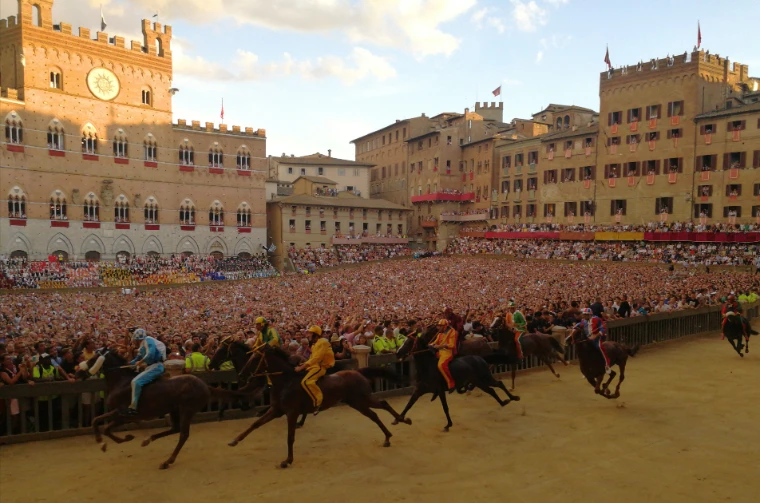
The Palio di Siena is a horse race three times round the Piazza del Campo, run on 2 July and again on 16 August between ten of the city’s seventeen contrade. The jockeys ride bareback, the race lasts about ninety seconds, and the prize is a banner of painted silk. Before it come three days of trials, and on the day a procession of some six hundred in costume, two hours entering the square.
The horse wins, not the jockey. A horse that crosses the line without its rider has won the Palio.
The Contrade
Siena raced horses in the thirteenth century. The oldest document, of 1238, fines a rider forty soldi for coming last in the August race and refusing his prize, which was a pig. Those early Palios ran straight through the city, from outside the walls to the cathedral, for a length of precious cloth, the pallium, which gave the race its name.
A race round the Campo appears in a print by Bernardino Capitelli of 1632. From 1656 the Madonna of Provenzano, an image said to work miracles, had a Palio of her own, and the July race has been run for her since. In 1701 the Goose, which had won that July, asked to run the race again on 16 August, for the Assumption, at its own expense, and in 1802 the city took the August Palio on. The rules of 1721 are the ground of the rules today.
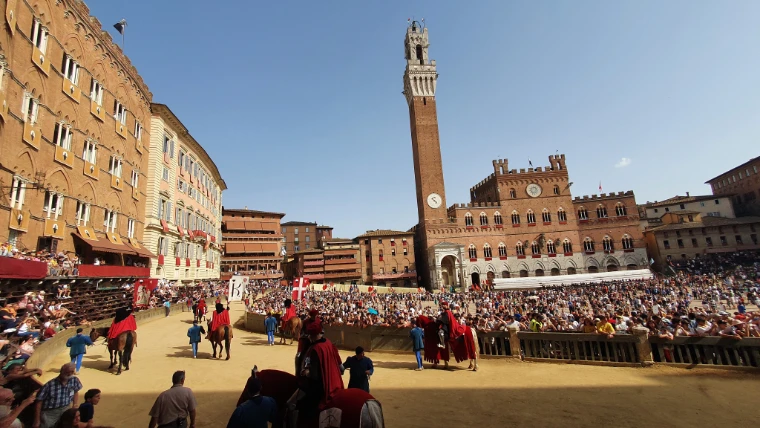
There are seventeen contrade, each a district with its own church, fountain, museum and club, and their boundaries have not moved since 1729. Their names are the Eagle, the Caterpillar, the Snail, the Owl, the Dragon, the Giraffe, the Porcupine, the Unicorn, the She-Wolf, the Shell, the Goose, the Wave, the Panther, the Forest, the Tortoise, the Tower and the Ram. A Sienese usually belongs to one by birth, and is baptised at its fountain.
Most have a rival, and a rival’s defeat is celebrated almost as a victory. The loser of the Palio is not the contrada that comes last but the one that comes second. In 1896 the Snail, having lost, threw its statue of St Anthony, the patron of horses, down a well. He was brought up in 1910, and the Snail won the next year.
Ten contrade run each Palio: the seven that did not run it the year before, and three more drawn by lot.
The Four Days
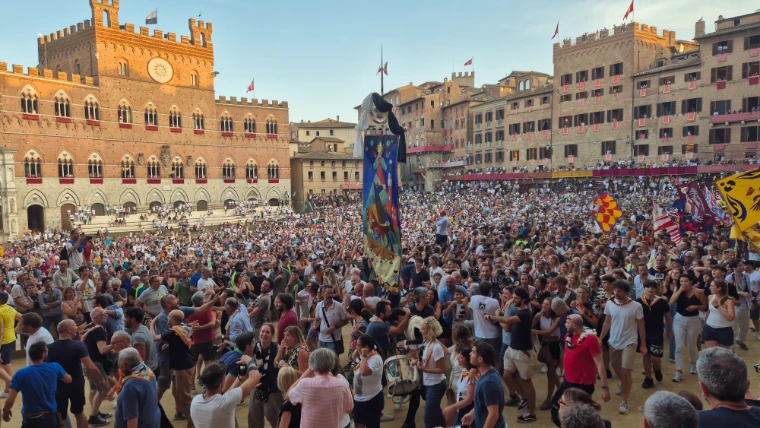
Three days before the race the horses are tried on the Campo, ten are chosen, and they are drawn by lot to the contrade on a stage in front of the Palazzo Pubblico. The horse cannot be changed; the jockey can, until the morning of the race. The jockeys are professionals, hired for the day, and the dealings between contrade and riders beforehand, called partiti, are part of the Palio too.
Six trials follow, one each morning and evening. On the evening before the race, after the trial called the prova generale, each of the ten contrade dines in its own streets at long tables, sometimes for more than a thousand, and the captain and the jockey speak.
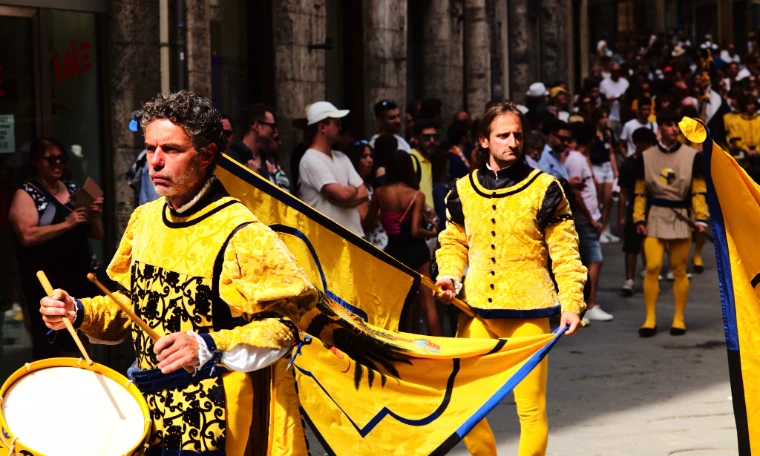
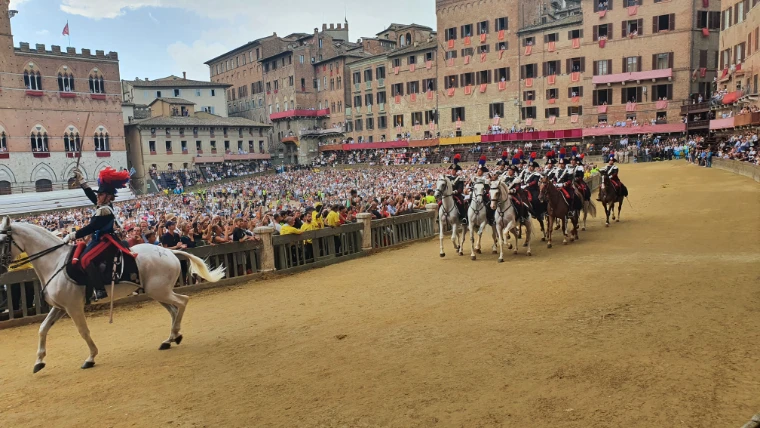
On the day the Archbishop says the jockeys’ Mass at eight in the morning. In the afternoon each horse is led into its contrada’s church and blessed at the altar, and the priest sends it out with “Go, and come back a winner.” The mounted Carabinieri ride round the track with sabres drawn, a lap at a walk and a lap at a gallop. Then the Corteo Storico enters, nearly six hundred figures in costume, with the banner drawn last on a cart behind four oxen.
The horses come out at half past seven in July and at seven in August. Nine wait between two ropes in an order drawn by lot; the tenth comes in from behind, and when it does the rope drops. The waiting can last an hour. Then three laps of the tuff, clockwise, past the San Martino corner, padded with mattresses since 1841, and it is over.
The banner, painted on silk by a different artist each time, goes to the winner’s museum for good.
In 2026 both races were put off for rain. The July Palio, run on the 3rd, went to the Eagle, its first win in thirty-four years. The August Palio, put off twice, to the 18th, went to the Shell, its first since 1998. One jockey, Giovanni Atzeni, called Tittia, rode both winners.
What to Know
The races are run on 2 July and 16 August in the early evening, and when it rains they are put off to the next day.
The centre of the Campo is free and fills from the morning. Once the gates close in the afternoon, those inside stand some three hours in the sun before the start; children under ten, glass, alcohol and chairs are not allowed in.
Seats on the stands round the track, and places at the windows and balconies above it, are let privately by those who hold them, at several hundred euros a seat and a great deal more for a window. There is no ticket office. The stands have no lavatories, and once seated one stays seated.
There is no dress code. A light suit and a hat; it is July, or August, in Tuscany.
Siena is an hour and a half from Florence by train, and a little less by the fast bus. The city fills for the Palio, and rooms should be taken early.
The mistake is to plan for the race day alone. The July Palio has been put off by rain three years running, and in 2026 the August race slipped by two days.
The Court
The Palio di Siena is not the Court’s own. Places on the stands, or at a window over the track, are sought on a member’s behalf, and the Court arranges the whole of it: getting there, where to stay in Siena or in the country round it, and the table afterward. The trials are free to watch, and the Court can arrange for a member to see a horse blessed.
How one becomes a member is set out under Admission.
Set down October MMXXVI