LAST NIGHT OF THE PROMS
Mid September · The Royal Albert Hall, London · An Evening · Since 1895
2027: dates to follow
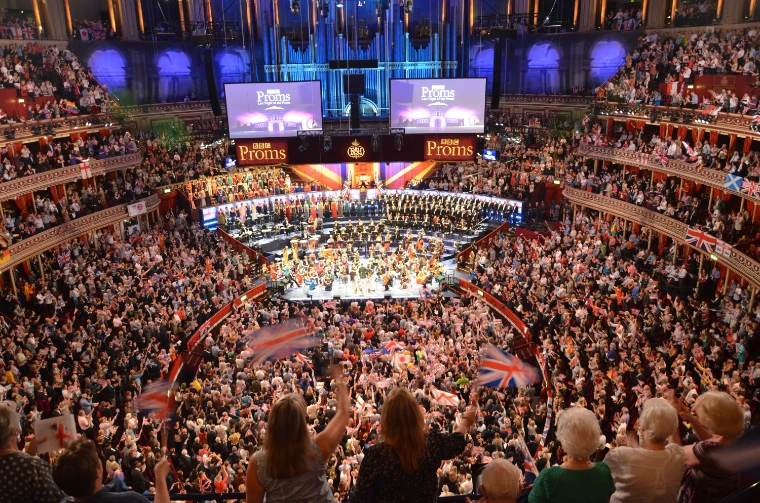
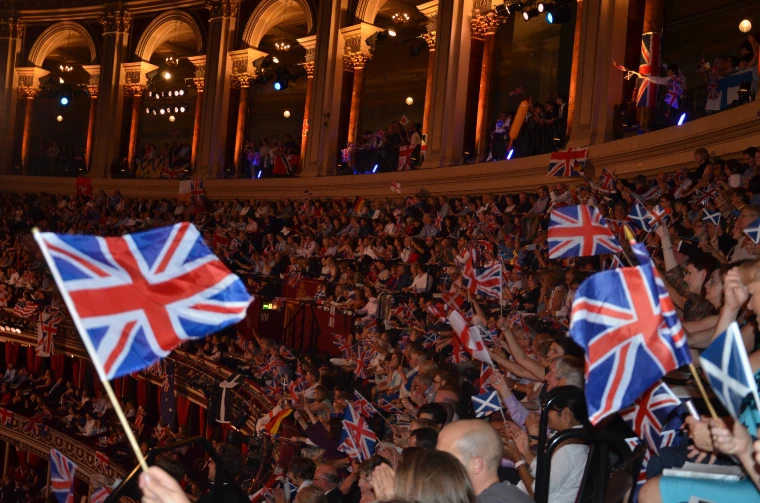
Last Night of the Proms is the final concert of the BBC’s summer season of Proms at the Royal Albert Hall in London, usually on the second Saturday in September: an evening of lighter popular classics in the first half and, in the second, a sequence that does not change, Wood’s Fantasia on British Sea-Songs, “Rule, Britannia!”, “Land of Hope and Glory”, “Jerusalem”, the National Anthem and “Auld Lang Syne”, sung by the whole hall with flags in its hands. More than a thousand of them stand, in the Arena and the Gallery.
On the Last Night the Promenaders crown the bust of Henry Wood with laurel. It was recovered from the ruins of the hall where the Proms began.
The Queen's Hall
The impresario Robert Newman began the Proms on 10 August 1895 at the Queen’s Hall, in Langham Place, with low prices and an informal room, where the audience could eat, drink and smoke. Henry Wood, who was twenty-six, conducted every concert, and the first opened with Wagner’s overture to Rienzi.
Elgar’s first Pomp and Circumstance March had its first Proms performance in 1901, and the audience had it played twice more as an encore; the repeat on the Last Night goes back to that evening. The BBC took the Proms on in 1927.
In May 1941 the Queen’s Hall was destroyed in an air raid, and the Proms moved to the Royal Albert Hall, where they have been held every summer since. That year Wood thanked his colleagues and the sponsors from the platform on the Last Night, and the conductor’s speech has followed ever since. The closing sequence was settled in 1954, under Malcolm Sargent.
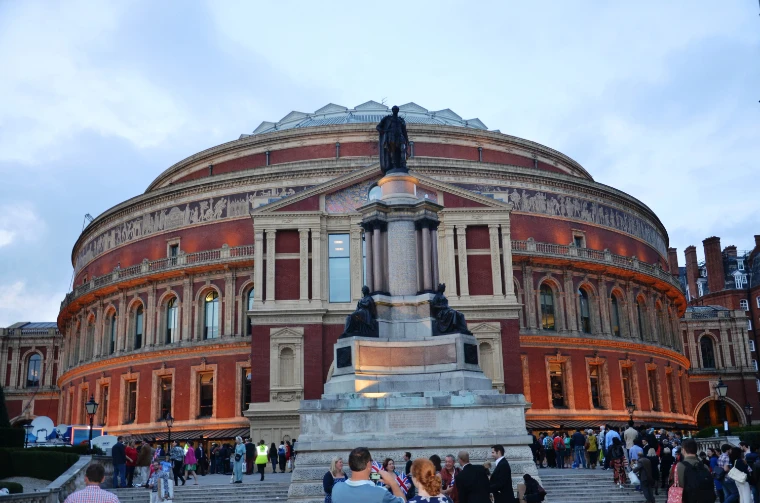
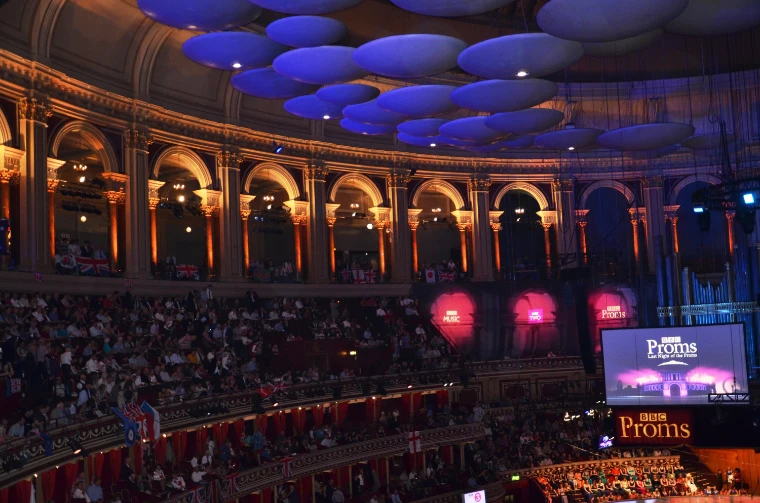
The Hall was opened by Queen Victoria on 29 March 1871, and holds 5,272. Her only recorded comment on it was that it reminded her of the British constitution.
Leonard Slatkin, in 2001, was the first American to conduct the Last Night, and Marin Alsop, in 2013, the first woman. In 2022 it was cancelled forty-eight hours before, on the death of Queen Elizabeth II, the first Last Night lost since 1944. Jiří Bělohlávek called the Proms “the world’s largest and most democratic musical festival”.
The Last Night
The Prommers stand in the Arena, before the platform, and in the Gallery, at the top of the Hall; there are more than a thousand standing places at every concert. The rest of the Hall is seated, in the stalls, the boxes and the circle.
The first half is broadcast on BBC Two and the second on BBC One, and the whole on Radio 3. Across the country Proms in the Park are joined to the Hall by screen for the finale. Union Flags are waved through the second half, and most of all in “Rule, Britannia!”. Some come in fancy dress, “from dinner jackets to patriotic T-shirts”.
The conductor makes a speech from the platform, as Wood first did in 1941.
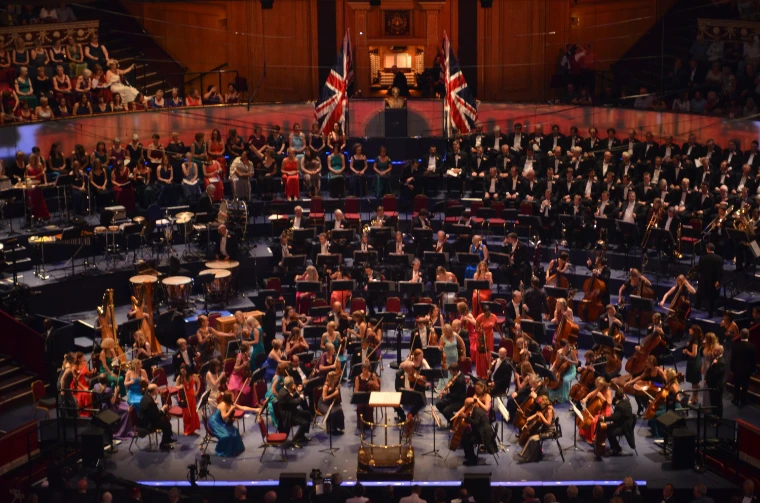
In 2026 the Last Night was on Saturday 12 September, from a quarter past seven to half past ten, the eighty-sixth concert of the season and the BBC’s ninety-ninth as custodian. Sakari Oramo conducted the BBC Symphony Orchestra, and Yuja Wang played Barber’s Piano Concerto, its first performance at the Proms. Nicky Spence sang “Rule, Britannia!” in a kilt with “a rainbow interior”, and Beverley Knight sang Dolly Parton while the hall lit its telephones. There were “nearly as many EU flags as there were UK ones”. Some seventy thousand £8 Promming tickets were sold over the season.
What to Know
It is usually on the second Saturday in September, at the end of an eight-week season. The 2027 dates have not been announced.
Most tickets are allotted by ballot. The Five-Concert Ballot is for those who have bought tickets to at least five other concerts in the season, two Last Night tickets at most, and closes in early June. The Open Ballot, for a hundred seats in the Centre Stalls and a hundred in the Front Circle, closes in early July. What is left goes on general sale on the day the season opens, two to a booker; a pass for the whole season includes the Last Night, and Promming tickets are sold online at £8 from half past nine on the morning. Tickets that change hands should do so at face value; the BBC recommends Twickets.
The BBC says: “Come as you are: there is no dress code at the Proms.” A lounge suit. Nothing is required, and the Hall can get very warm.
The Hall stands on the northern edge of South Kensington. One bag is allowed, of twenty-five litres at most, and the cloakroom costs £1 an item.
The mistake is to leave it until September. The ballots close in June and July, and after them there is only the general sale, the Promming queue on the day, and resale at face value. A flag larger than half a metre by a metre, or on a telescopic pole, is not let in.
The Court
Last Night of the Proms is not the Court’s own. Seats in the stalls or a box are sought on a member’s behalf through the ballots, and the Court arranges the whole of it: getting there, where to stay in Kensington, and the table afterward.
How one becomes a member is set out under Admission.
Set down October MMXXVI