
THE BAYREUTH FESTIVAL
Late July into August · The Festspielhaus, Bayreuth · Five Weeks · Since 1876
2027: 25 July to 24 August
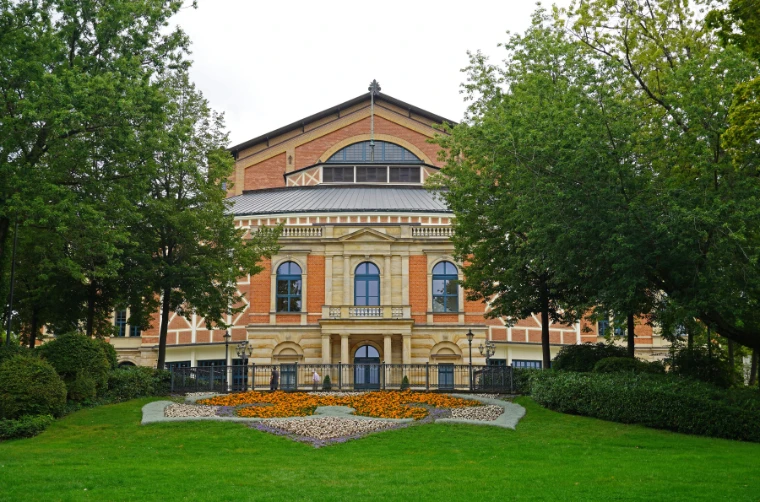
The Bayreuth Festival is five weeks of Wagner and almost nothing else, from 25 July into late August, in the theatre on the Green Hill above the Franconian town of Bayreuth that Wagner built for his own works. Ten of his operas make the whole of the repertoire, the Ring among them, and his great-granddaughter runs it. The orchestra plays out of sight, sunk beneath the stage, and the stalls have no aisle: the rows are reached by doors along the side walls.
There is no bell. A quarter of an hour before each act, brass players come out onto the balcony of the house and play a fanfare on a theme from the opera, as they have since 1876, in almost any weather.

The Festspielhaus
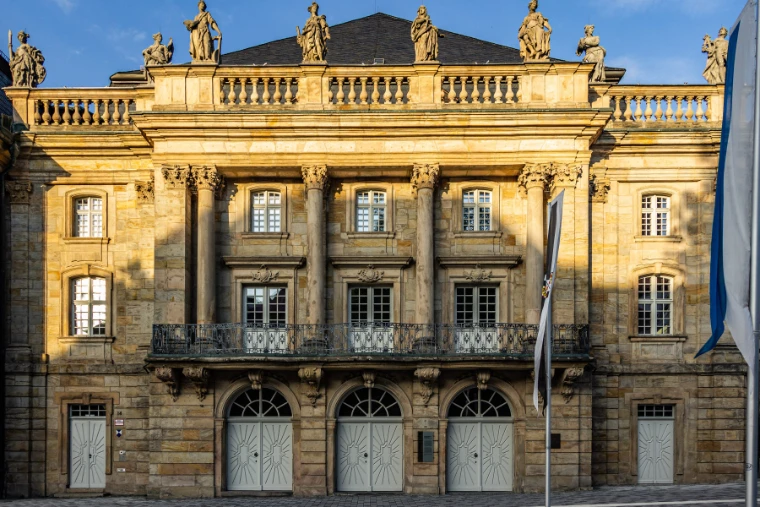
Wagner wanted a theatre of his own for the Ring as early as 1850, a temporary one “out of boards”, where the four operas could be given over three days and an evening before. He thought of Zurich, of Weimar and of Munich before the conductor Hans Richter pointed him to the Margravial Opera House at Bayreuth. He found its auditorium too small, but liked the town, and the town gave him a site on the hill.
The foundation stone was laid in pouring rain on his fifty-ninth birthday, 22 May 1872, and that evening he conducted Beethoven’s Ninth in the Margravial Opera House. The patrons’ certificates he sold did not pay for the building, and Ludwig II of Bavaria lent him the rest. The house was plain red brick, meant to be provisional, and was called the barn.
The first festival opened on 13 August 1876 with Das Rheingold, Richter conducting, before the Kaiser, the Emperor of Brazil, Liszt, Bruckner, Tchaikovsky, Grieg, Tolstoy and Nietzsche. “I didn’t believe you would bring it about,” the Kaiser told Wagner. The gas lighting failed as it began and left the house in darkness, and Wagner kept the darkness. The festival lost a fortune, and the house stood empty for six years, until Parsifal in 1882.
His widow Cosima ran it after him, then his son Siegfried, then Siegfried’s English widow Winifred, a friend of Hitler, under whom Bayreuth became what Thomas Mann called Hitler’s court theatre. It reopened in 1951 under Wagner’s grandsons Wieland and Wolfgang, and Wolfgang’s daughter Katharina has run it since 2008, alone since 2015.
The Five Weeks
The house seats about nineteen hundred on a single steep wedge of plain wooden chairs without arms, with boxes and galleries only at the back, so that there should be no ranks in the audience. It has no air conditioning. Performances begin at four in the afternoon, most of them, with intervals of an hour, as at the first festival, and the audience walks out onto the hill between the acts until the fanfare calls it back.
The orchestra sits in the covered pit, sunk beneath the space Wagner called the mystic gulf, its loudest instruments lowest, and the conductor is the only person in the house who can see both the stage and the players.
In 2026, its hundred and fiftieth year, Christian Thielemann conducted Beethoven’s Ninth on the opening night, and Rienzi, Wagner’s early opera, was given at Bayreuth for the first time.
What to Know
The festival opens on 25 July and runs into late August: in 2027, from 25 July to 24 August, with new productions of Lohengrin and Parsifal. Orders for 2027 close on 12 October 2026; what is left is sold online from 6 December.
Tickets are ordered online by a deadline, at most four a performance, and are personal; the old waiting list of ten years and more is gone, and everyone now has the same chance. The best seats cost some €450.
The festival has no dress code, only, it says, the festive character of the evening. Many men wear dinner jackets; it can be hot in the house.
Bayreuth is under an hour by regional train from Nuremberg, the nearest airport and the nearest stop for the fast trains. The Goldener Anker, in the same family for generations, has been an inn since 1753.
The mistake is to bring a cushion. One’s own is not allowed in the house, though one can be borrowed at the cloakroom, and only a small handbag, held on the lap.
The Court
The Bayreuth Festival is not the Court’s own. Tickets are ordered on a member’s behalf before the deadline in October, and the Court arranges the whole of it: getting there, where to stay in Bayreuth or Nuremberg, and the table afterward, booked in advance, since the kitchens close before a long opera ends. The Court is in Salzburg the week before.
How one becomes a member is set out under Admission.
Set down October MMXXVI